
Sliced by slammed door, fingertip rebuilt with same finger's tissues
Dr Pankaj Jindal
The day my finger was amputated, my whole world collapsed,” said the 23-year-old man on a visit to my clinic in Sept 2024, nearly six months after a freak accident had his finger caught between a slammed door and made him lose the fingertip.
What stood out was not the severity of the injury, but the emotional silence surrounding it. He came expecting to hear exactly what he had heard from several doctors before: that no further treatment was possible or that he should wear a slip-on silicone cap. Despair was written all over his face. After a quick look, when I assured him that his finger could be reconstructed, his eyes lit up. There were tears in his mother’s eyes. Both spoke almost simultaneously, “How soon?” After the nitty-gritty was explained, he was taken for surgery in a few days.
Traditional options for fingertip reconstruction are limited and often involve prolonged recovery or complex procedures. For this patient, the goal was modest but meaningful — to restore normalcy quickly without subjecting him to extensive surgery or long rehabilitation.
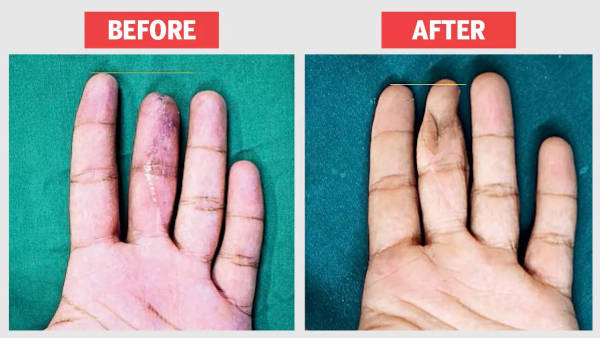
We deployed a novel reconstructive surgical technique. Using the patient’s own finger tissues, the injured finger was reconstructed and regained length and shape over the following months. Like a flip phone, a part of the remaining finger was split open for that. Then, using high magnification and the precision of a goldsmith crafting fine jewellery, the middle bone of the affected finger and the skin covering it were gently sliced into two halves. The front half, which carries its own healthy skin and the underlying bone, was gently reflected distally on a skin hinge at the end of the injured stump of the finger to gain the planned additional length. This formed the new terminal bone, gaining 10–14 mm of finger length.
It may sound easy but requires the highest level of safety as the nerve and blood supply, the joint, and the tendon are in close vicinity. To cover this new structure, we borrowed a skin flap from an adjacent finger. The recovery was rapid and smooth, with minimum scarring. It was far superior to artificial fingers or distant tissue grafts.
Complex microsurgery and other mechanical instrument-based techniques have prolonged recovery and rehabilitation with sky-high costs. Our technique can be carried out without hospitalisation if the patients desire. They are back to full functional capacity within just three months.
With the passage of time, the bone regained its original girth. One unexpected but noteworthy benefit was the appearance of the reconstructed fingertip on the back side, which developed a lighter tone resembling a nail. To an onlooker, the finger no longer appeared injured. The physical appearance was impressive and the functional restoration, remarkable. The icing on the cake was the visual transformation.
Seeing a near-normal finger again was a powerful psychological boost for the man who had shut himself off from the world. The reconstructed finger no longer drew even his own attention; his confidence rose meteorically. Today, he has resumed his routine activities and interactions, works comfortably on a computer and in the field, and no longer hides his hand during conversations. His parents said the change was perceptible and a great relief.
Hand injuries are not merely about loss of function. They affect one’s whole identity. The hand is always visible. Even a small deformity can affect self-esteem and confidence in some individuals. For unmarried young adults, fears about acceptance, career prospects, and social judgement can become overwhelming.
Dr Pankaj Jindal is hand surgeon with Ratna Memorial Hospital, Pune. He spoke to Steffy Thevar
The day my finger was amputated, my whole world collapsed,” said the 23-year-old man on a visit to my clinic in Sept 2024, nearly six months after a freak accident had his finger caught between a slammed door and made him lose the fingertip.
What stood out was not the severity of the injury, but the emotional silence surrounding it. He came expecting to hear exactly what he had heard from several doctors before: that no further treatment was possible or that he should wear a slip-on silicone cap. Despair was written all over his face. After a quick look, when I assured him that his finger could be reconstructed, his eyes lit up. There were tears in his mother’s eyes. Both spoke almost simultaneously, “How soon?” After the nitty-gritty was explained, he was taken for surgery in a few days.
Traditional options for fingertip reconstruction are limited and often involve prolonged recovery or complex procedures. For this patient, the goal was modest but meaningful — to restore normalcy quickly without subjecting him to extensive surgery or long rehabilitation.
We deployed a novel reconstructive surgical technique. Using the patient’s own finger tissues, the injured finger was reconstructed and regained length and shape over the following months. Like a flip phone, a part of the remaining finger was split open for that. Then, using high magnification and the precision of a goldsmith crafting fine jewellery, the middle bone of the affected finger and the skin covering it were gently sliced into two halves. The front half, which carries its own healthy skin and the underlying bone, was gently reflected distally on a skin hinge at the end of the injured stump of the finger to gain the planned additional length. This formed the new terminal bone, gaining 10–14 mm of finger length.
It may sound easy but requires the highest level of safety as the nerve and blood supply, the joint, and the tendon are in close vicinity. To cover this new structure, we borrowed a skin flap from an adjacent finger. The recovery was rapid and smooth, with minimum scarring. It was far superior to artificial fingers or distant tissue grafts.
Complex microsurgery and other mechanical instrument-based techniques have prolonged recovery and rehabilitation with sky-high costs. Our technique can be carried out without hospitalisation if the patients desire. They are back to full functional capacity within just three months.
With the passage of time, the bone regained its original girth. One unexpected but noteworthy benefit was the appearance of the reconstructed fingertip on the back side, which developed a lighter tone resembling a nail. To an onlooker, the finger no longer appeared injured. The physical appearance was impressive and the functional restoration, remarkable. The icing on the cake was the visual transformation.
Seeing a near-normal finger again was a powerful psychological boost for the man who had shut himself off from the world. The reconstructed finger no longer drew even his own attention; his confidence rose meteorically. Today, he has resumed his routine activities and interactions, works comfortably on a computer and in the field, and no longer hides his hand during conversations. His parents said the change was perceptible and a great relief.
Hand injuries are not merely about loss of function. They affect one’s whole identity. The hand is always visible. Even a small deformity can affect self-esteem and confidence in some individuals. For unmarried young adults, fears about acceptance, career prospects, and social judgement can become overwhelming.
Dr Pankaj Jindal is hand surgeon with Ratna Memorial Hospital, Pune. He spoke to Steffy Thevar
Contact to : xlf550402@gmail.com
Copyright © boyuanhulian 2020 - 2023. All Right Reserved.