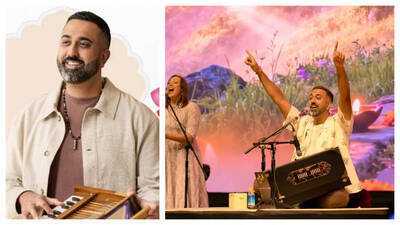
After drawing a staggering 15,000-strong crowd in New Delhi on his last visit, UK-based kirtan musician Radhika Das is set to return to India for his second tour; and this time, the devotion promises to run even deeper.
Known for transforming concert venues into collective meditations through mantra chanting, immersive soundscapes and heartfelt storytelling, the artist believes today’s youth are leading a quiet spiritual revival. “Every time I return to India, I feel like the mantras are coming home. What intrigues and excites me is seeing youth embrace kirtan so openly. There's a real hunger for meaning and connection right now, and devotional music is meeting that moment,” he says, as he prepares to bring his internationally touring ensemble to India.
In an exclusive conversation with Bombay Times , Radhika Das reflects on identity, authenticity, and why bhakti, for him, is less about performance and more about purpose. Excerpts...
Your upcoming India tour, your second, comes at a time when devotional music is finding new audiences globally. What has changed in your artistic vision since your first India tour, and how do you plan to deepen the spiritual and cultural engagement with Indian listeners this time?
During my first India tour, I was focused on establishing connection. Introducing a format that blended immersive production with traditional kirtan. This time, the intention feels more refined. There’s greater clarity about pacing, storytelling, and emotional arc.
As Ravi Pattni, your journey into becoming Radhika Das represents a profound personal and artistic transformation. How has this evolution reshaped your understanding of identity, fame, and purpose — and what challenges have you faced in balancing spiritual authenticity with growing global recognition?
The transition wasn’t about reinvention; it was about alignment. “Radhika Das” my spiritual name, represents an intention, to serve through music. Over time, I’ve come to see identity as something fluid and purpose-driven rather than fixed.
With growing visibility comes responsibility. The challenge is to remain grounded and sincere, to ensure that recognition doesn’t become the goal. For me, the anchor is pleasing Guru and God. If the inner life remains steady, the external attention doesn’t distort it.
Your music is deeply rooted in Bhakti traditions yet resonates strongly with contemporary audiences. How do you strike a balance between spiritual authenticity and modern musical appeal?
For me, the balance comes from keeping the mantra, its meaning and thus the essence at the centre of everything. The spiritual essence never changes. The intention, the devotion, the sacred sound remain untouched. What evolves is the musical landscape around it. Modern production, sound design, and arrangements simply become tools to help the mantra travel further and reach hearts that might never step into a temple or traditional kirtan space.
Can you take us back to the beginning of your journey? What first drew you to Bhakti music and Kirtan as a life path?
I discovered kirtan in London in my late teens / early twenties, during a time when I was searching for direction and meaning. The first time I heard a room full of people chanting together, I felt a sense of peace, connection to something higher and a belonging that stayed with me. Over time, what began as curiosity became daily practice, and eventually a calling to share this experience with others.
Your live kirtan gatherings are known to be immersive and transformative. What do you hope listeners experience or take away from your performances?
I hope people leave feeling lighter, more connected, and more themselves. Whether someone sings loudly, sits quietly, or simply listens, the aim is to create a space where people can let go and feel held by God. If someone walks away with even a moment of inner meaning or joy, the gathering has served its purpose.
You’ve performed across countries and cultures. How do international audiences respond to Bhakti music, especially those unfamiliar with its roots?
The emotional response is often the same everywhere. Even when people don’t understand the language, they understand the feeling. Music and repetition create a shared emotional space, and that sense of connection transcends cultural boundaries.
At a personal level, how has walking the Bhakti path transformed you as an artist and as an individual? And what advice would you give young seekers drawn to this space?
Bhakti has given me clarity, discipline, and purpose. It has helped me approach music as service rather than performance. My advice to young seekers is simple: start with sincerity. You don’t need to have everything figured out, just begin with an open heart and allow the journey to unfold.
Sita Rama Jaya is deeply rooted in devotion — what inspired you to interpret this chant in your own voice, and what personal meaning does it hold for you at this stage of your journey?
This chant carries a feeling of joy and celebration for me. It felt like the right mantra to share at this moment. Something uplifting, hopeful, and accessible. It reflects where I am in my journey: wanting to share devotion in a way that feels welcoming and alive.
Your music sits at the intersection of faith, performance, and popular culture. Do you see your music as a spiritual movement, a musical innovation, or a cultural disruption — and what responsibility comes with shaping a new devotional experience for younger generations?
I see it as a bridge. It’s less about disruption and more about accessibility. If devotional music is reaching people who might never have encountered it otherwise, then something meaningful is happening.
With that comes responsibility: to maintain authenticity, to honour tradition, and to avoid reducing sacred sound to spectacle. The aim is not reinvention, but renewal.
Contact to : xlf550402@gmail.com
Copyright © boyuanhulian 2020 - 2023. All Right Reserved.