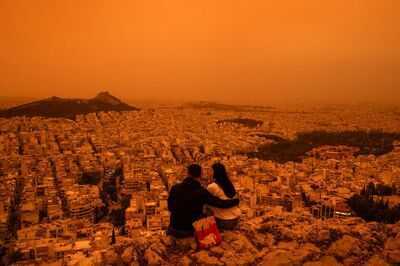
Brits could be battered by 'blood rain' during a rare weather phenomenon set to engulf parts of Europe.
A Saharan dust cloud is set to sweep across parts of Spain and the Balearic Islands, hitting major holiday hotspots such as Tenerife, Lanzarote, Gran Canaria, Majorca, Menorca and Ibiza. The phenomenon, known as Calima, is being driven by a high-altitude, isolated depression (DANA) that is transporting large amounts of sand from Morocco and Mauritania into southern Europe.
Instead of basking in the Spanish heat, tourists face the prospect of orange-tinted dust, hazy skies and reduced visibility. The Spanish weather agency, AEMET, also warned that calima "worsens air quality due to microscopic particles, which can reach the respiratory tract".
• Foreign Office warns about Turkey after seven Brits die
• Passport holders told to take action now or risk 'being turned away at airport'
Holidaymakers and locals should also brace themselves for "blood rain," which occurs when the orange dust is mixed with rain. Heavy rain has been predicted for parts of Spain, which could result in thick layers of dust engulfing the Spanish hotspots, dramatically changing the scene, leaving cars scattered with dust and murky swimming pools.
The weather is forecast to be worse in the southeast parts of Spain, along the Mediterranean coast and the Balearic Islands. The AEMET issued a weather warning on X, formerly Twitter, and said: "Very adverse weather in the Canary Islands: showers that could be very heavy, today accompanied by storms in the eastern islands; very strong wind gusts; rough seas."
The agency noted on Sunday that the "weather is expected to improve." The phenomenon has also brought an unusually warm air mass, with soaring temperatures up to 25C in southeastern regions and the Canary Islands, and Bilbao hitting a blistering 27C in February.
This isn't the first time the Canary Islands have experienced a calima, including Lanzarote, which typically occurs during the winter months. The calima is a hot, oppressive wind that arises when high pressure builds over the Sahara, subsequently driving winds that carry Saharan temperatures and sand.
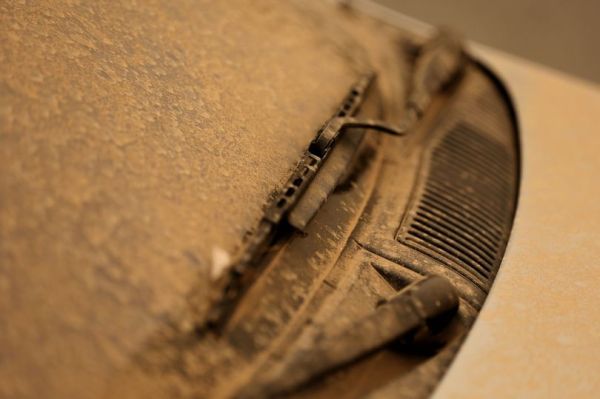
Explaining further, Lanzarote Information said: "During a calima, the air turns a white or even a yellow colour and you can literally smell the sand in the air from the Desert.
"Visibility is reduced, and there's a kind of otherworldly quality to the light. Often strange insects accompany the winds – in recent years we have had locusts, ladybirds and dragonflies that arrive on the island.
"They rarely last for very long here, as there is so little for them to eat due to the desert nature of Lanzarote. Sometimes unusual birds are blown over on the wind as well, so look out for them."
Ensure our latest lifestyle and travel stories always appear at the top of your Google Search by making us a Preferred Source. Click here to activateor add us as your Preferred Source in your Google search settings.
Do you have a travel story to share? Email webtravel@reachplc.com
Contact to : xlf550402@gmail.com
Copyright © boyuanhulian 2020 - 2023. All Right Reserved.