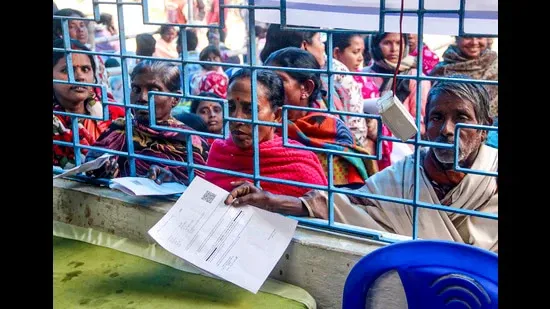
West Bengal SIR petitioner’s voter status under adjudication
A 44-year-old homemaker from Bhagabangola village in Murshidabad district, Mostari Banu, who was the first person from West Bengal to move the Supreme Court against the Election Commission of India's (ECI) special intensive revision (SIR) of electoral rolls, finds herself awaiting adjudication in the post-SIR final rolls.
In the final electoral roll, released on February 28, Banu's name appears in Section 2 (Manik Mandaler Pada) for 62-Bhagabangola assembly constituency, stamped as "Under Adjudication", indicating her voter status remains pending judicial review.
Banu, the lead petitioner in the case against SIR in West Bengal, is among 6,006,675 names that have been marked under adjudication - a process where judges assess individual cases before inclusion or deletion from the rolls - in the final roll. The SIR exercise, which began in the state on November 4 last year, also saw around 6.17 million names being deleted in the final rolls.
The final roll was released on the top court's directives even as adjudication by judicial officers continues, leaving the option for supplementary lists at a later stage.
Banu had filed a writ petition in the Supreme Court in November 2025, weeks after ECI announced the SIR in the eastern state. She had initially challenged the ECI's requirement for passport-size photographs on enumeration forms, arguing it forced Muslim women, who observe parda (covering heads and foreheads), to choose between "their religion and their right to vote". Hours before the first hearing on November 10, ECI clarified that photographs were not mandatory.
However, her challenge soon widened to attack the entire SIR framework - especially the "logical discrepancy" criteria that flagged voters for reasons such as age mismatches, discrepancies in parent names and anomalies in family data.
It was in Banu's petition that the apex court passed several key directives in connection with the SIR exercise in West Bengal, including the appointment of judicial officers, acceptance of Class 10 marksheets as proof of age, and other facilitative measures. In her petition against ECI, Banu challenged the tagging of voters under "logical discrepancies," including age mismatches, discrepancies in parents' names and unusual family data gaps, which she claimed affected nearly 14 million voters, particularly in Muslim-majority districts of Murshidabad and Malda - both bordering Bangladesh.
To be sure, the two districts account for the highest number of voters marked "under adjudication" by ECI in the final roll. While Murshidabad accounts for 1.1 million such voters, Malda recorded nearly 800,000 such voters.
Notably, it was the Banu's case in which West Bengal chief minister and TMC chief Mamata Banerjee personally appeared and argued before the apex court in related proceedings.
Acting on the petition, the top court first recorded ECI's clarification on November 10 last year, that photographs were not mandatory, and later on January 19, 2026, directed public display of discrepancy lists, permitted authorised representatives to file claims, and granted additional time for submissions. Last month, citing a "trust deficit", the top court directed the chief justice of the Calcutta high court to appoint serving and former judicial officers to adjudicate pending cases - a process that continues as the matter awaits final adjudication.
Contact to : xlf550402@gmail.com
Copyright © boyuanhulian 2020 - 2023. All Right Reserved.