
New Delhi: Amazon’s cloud arm is facing one of its most serious infrastructure crises in recent years. Amazon Web Services confirmed that drone strikes damaged three of its data center facilities in the Middle East, leading to prolonged service disruptions.
The company disclosed that two facilities in the UAE were directly hit, and another site in Bahrain suffered infrastructure damage after a nearby drone strike. The impact has already rippled across businesses that rely on AWS for computing, storage, and databases.
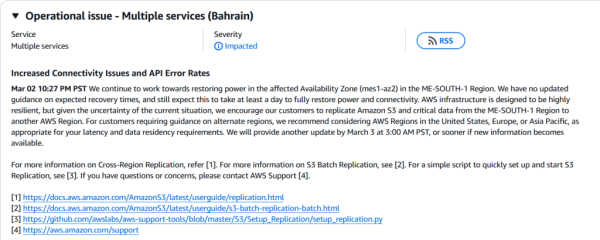
AWS Health Status Page
Drone strikes hit key AWS regions
AWS said that drones had “directly struck” two facilities in the UAE. In Bahrain, a strike near a facility caused physical damage to infrastructure. The company added that customers are seeing elevated error rates and degraded availability.
In a public statement, AWS said, “We are working to restore full service availability as quickly as possible, though we expect recovery to be prolonged given the nature of the physical damage involved”.
On its health status page, AWS provided more details. It confirmed that in the ME-CENTRAL-1 region in the UAE, two of three Availability Zones remain significantly impaired. The third zone continues to operate normally, though some services face indirect impact.
Across the UAE and Bahrain regions, customers are experiencing issues with services such as Amazon EC2, Amazon S3, Amazon DynamoDB, AWS Lambda, Amazon RDS, and even the AWS Management Console.
Recovery may take time
AWS acknowledged the scale of the physical damage. On its status page, it said, “We still estimate that the recovery time is at least a day before we are able to fully restore power and connectivity” .
The company is working on two fronts:
- Physical restoration of damaged facilities
- Software-based mitigations to restore services
It noted that it is prioritising foundational services like Amazon S3 and Amazon DynamoDB, since restoring them will help other dependent services recover.
AWS has advised customers in the Middle East to back up data and consider migrating workloads to alternate regions. It recommended considering regions in the United States, Europe, or Asia Pacific, depending on data and latency needs.
Wider economic impact
The disruption comes amid the US-Iran conflict that has affected energy markets and shipping routes. Oil prices have spiked, and tanker traffic through the Strait of Hormuz has slowed sharply.
AWS operates 123 zones across 39 regions globally. Even so, for companies that concentrated workloads in the Middle East regions, the coming days could be challenging.
AWS says it will continue to provide updates as recovery progresses. The operating environment in the Middle East, it admits, remains unpredictable.
Contact to : xlf550402@gmail.com
Copyright © boyuanhulian 2020 - 2023. All Right Reserved.