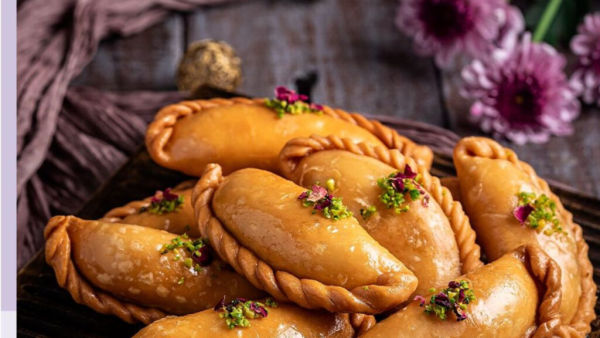
New Delhi:The sweetness whose fragrance first touches the mind when the name of Holi is mentioned is Gujiya. Golden crust fried in ghee, fragrant mawa filled with cardamom inside and crunchy dry fruits – this taste is not just a sweet, but a part of tradition. This half-moon shaped sweet has become the identity of festivals in North India.
But do you know that the history of Gujiya is not limited to Indian kitchens only? Many historians believe that it is also to the famous Turkish dish Baklava. Over time, this sweet has passed through different cultures and cooks and has come to us in the form it has today.
Indications of Gujiya are found from the 13th century.
According to historians, the initial form of Gujiya had become a part of Indian cuisine around the 13th century. There is mention of a dish called ‘Gunjha’ in Sanskrit and regional texts. From this it is estimated that the history of Gujiya is about 700 to 800 years old.
India’s famous food historian K.T. KT Achaya has given a detailed description of the evolution of Indian cuisine in his books ‘A Historical Dictionary of Indian Food’ and ‘The Story of Food’. According to him, the tradition of stuffed and fried pastries is centuries old in India, which varied over time and region. There is mention of dishes like ‘Ganjha’ or ‘Puri’ in the literature of 13th-14th century, which are considered to be the early form of Gujiya.
Turkish connection and similarity to baklava
Some food historians link the concept of gujiya to the famous Turkish dessert baklava. Baklava is a flaky, sweet, dried fruit-filled pastry that was a favorite dish of Turkish sultans and the wealthy class.
According to reports, when traders from Central Asia came to India, they brought with them dishes like samosa and baklava. With time, samosa evolved into a salty form, while baklava was given a new form by combining Indian flavours. In Türkiye there was a tradition of filling dry fruits between layers of flour, which was replaced with mawa (khoya) in India and thus Gujiya was born.
Bundelkhand becomes the ‘fortress’ of Gujiya
Historians consider Bundelkhand to be the main center of Gujiya. During the medieval period, when changes were taking place in the food habits of North India, the kings and royal chefs of Bundelkhand created ‘Chandrakala’ i.e. round Gujiya. From here this sweet spread to Braj region and then to Uttar Pradesh, Madhya Pradesh and Bihar.
Quoting historian Sanjesh Tripathi, the report says that people who went abroad for trade brought the idea of pastry to India and gave it a new shape with local ingredients like wheat or millet flour, khoya and dry fruits.
Royal identity in Braj and Mughal period
In Braj (Mathura-Vrindavan) during the 16th century, Gujiya along with cardamom and dry fruits was offered as Prasad to Lord Krishna. When the tradition of 56 Bhog started during the Bhakti period, dishes like ‘Chandrakala’ and ‘Gujiya’ were included in it. Old records of the temples show that this sweet is being made here for almost 500 years.
It got a more royal form during the Mughal period. The use of saffron and expensive dry fruits increased and its taste became richer.
How has Gujiya changed over time?
The form of Gujiya has gone through many changes over the centuries—
- 13th century: Plain sweet pakoda or puri-like form as ‘Gunjha’
- 15th-16th century: Filling of mawa and dry fruits started due to Central Asian influence.
- Mughal period: Rich look with saffron and royal dry fruits
- Today: Apart from traditional Mawa, modern flavors like chocolate, saffron, sugar-free
Different name and taste in every state
Wherever Gujiya reached, it adopted the local flavor –
- Maharashtra and Gujarat: Karanji, which uses coconut and jaggery
- Bihar and Jharkhand: Pidkia, a mixture of semolina and khoya
- Karnataka: Karjikai, with poppy seeds and coconut filling
Whether the history of Gujiya is linked to the Turkish court or the royal kitchen of Bundelkhand, today its real identity is its taste and aroma. This sweet not only adds sweetness to every festival, but also keeps the centuries-old cultural heritage alive.
Contact to : xlf550402@gmail.com
Copyright © boyuanhulian 2020 - 2023. All Right Reserved.