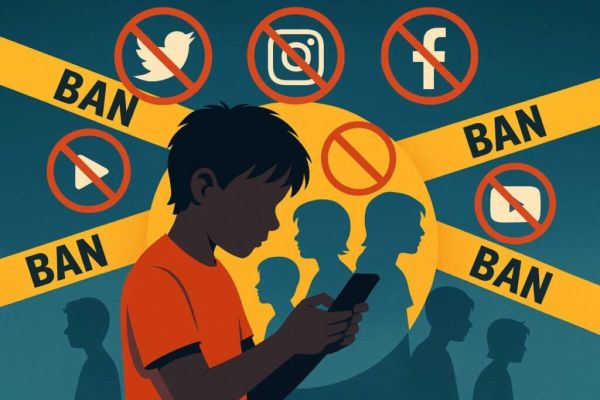
The Karnataka government has proposed a major step aimed at protecting young people online. In a move that has already sparked widespread discussion, the state plans to prohibit children under the age of 16 from using social media platforms. The announcement was made by Karnataka Chief Minister Siddaramaiah during the state’s budget speech on Friday.
The proposal places Karnataka among a growing number of governments worldwide that are exploring stricter controls on children’s access to social media. While the goal is to reduce the harmful effects of excessive online exposure, experts and industry players are questioning whether such a ban can actually be enforced and whether it may create unintended consequences.
In this article, we will delve into the details of Karnataka’s proposed social media restriction, the global trend of similar measures, and the legal and technological challenges surrounding the move.
Credits: Pamela Rutledge
Karnataka’s Plan to Restrict Social Media for Young Users
During his budget address, Chief Minister Siddaramaiah announced that the state government intends to prohibit social media use for children below 16 years of age. The move, he said, is aimed at protecting children from the negative effects of excessive smartphone and social media usage.
“To prevent the adverse effects on children from the use of mobile phones, the use of social media will be prohibited for children under the age of 16,” Siddaramaiah stated.
However, the announcement did not include details on how the rule would be implemented or monitored. Questions remain about whether platforms will be required to enforce the ban, whether parents will bear responsibility, or whether age verification systems will be introduced.
According to sources at two tech companies, the Karnataka government did not conduct consultations with major technology platforms before making the announcement.
A Growing Global Movement
Karnataka’s proposal reflects a broader international push to limit social media access for young users.
Concerns about the mental health impact of platforms such as TikTok, Instagram, Snapchat, and Facebook have been rising for years. Governments and policymakers have increasingly linked excessive social media use to issues such as anxiety, depression, online harassment, and exposure to harmful content among teenagers.
Australia became the first country to introduce a nationwide ban on social media use for teenagers in December. Several other countries have since begun exploring similar restrictions.
Indonesia announced that it plans to restrict users under 16 from accessing “high-risk platforms” such as YouTube, TikTok, Facebook, Instagram, Threads, X, and Roblox. Malaysia has also indicated that it is evaluating comparable regulations.
In India, the debate is gaining momentum at the national level as well. Officials in states such as Goa and Andhra Pradesh have said they are studying possible social media restrictions for minors. Earlier, the Madras High Court urged the central government to examine the feasibility of Australia-style restrictions. India’s Chief Economic Adviser V. Anantha Nageswaran has also suggested age-based limits on platforms he described as “predatory.”
Tech Companies Urge a Balanced Approach
Technology companies have responded cautiously to the idea of broad social media bans. A spokesperson for Meta said the company supports measures that allow parents greater control over teenagers’ online activity. However, the company warned that sweeping bans could drive teenagers toward less regulated spaces on the internet.
Meta also argued that social media restrictions targeting only a handful of platforms may not meaningfully improve safety. According to the company, teenagers use around 40 different apps every week on average. As a result, blocking a few major platforms may simply push young users to alternative or less secure services. Still, the company said it would comply with restrictions where they are legally enforced.
Credits: ddnews.gov.in
Legal and Constitutional Questions
Legal experts have also raised questions about whether a state government has the authority to impose such restrictions.
Aparajita Bharti, founding partner at tech and public policy consulting firm The Quantum Hub, suggested that the announcement appears more like a policy statement than a concrete regulatory plan. She noted that it is unclear whether a state government has the legislative power to implement such measures.
Bharti also emphasized that policymakers should consider India’s unique digital environment, where device sharing is common and internet access varies significantly across communities. Kazim Rizvi, founding director of New Delhi-based think tank The Dialogue, pointed out that internet regulation largely falls under the jurisdiction of India’s central government.
Contact to : xlf550402@gmail.com
Copyright © boyuanhulian 2020 - 2023. All Right Reserved.