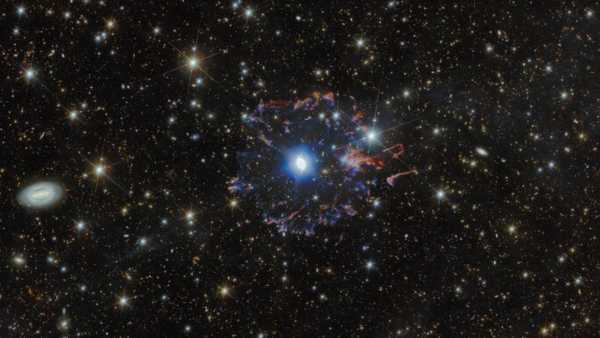
New Delhi: The Hubble and Euclid space telescopes have observed the Cat’s Eye Nebula, also designated as NGC 6543, at a distance of 4,400 lightyears away in the constellation of Draco. The Cat’s Eye Nebula is a well-known and well-studied nebula that has fascinated astronomers for decades because of its elaborate and multi-layered structure. The planetary nebula is caused by a dying star violently shedding its outer layers. In primitive telescopes, these objects resembled planets, hence the misnomer of ‘planetary nebula’, that has stuck. It was observations of the Cat’s Eye Nebula itself in 1864 that revealed that planetary nebulae were distinct from stars and galaxies.
Hubble has captured the core of the Cat’s Eye Nebula. (Image Credit: ESA/Hubble & NASA, Z. Tsvetanov).
The combined observations by Hubble and Euclid have revealed the remarkable complexity of the planetary nebula. Euclid is primarily designed to map the distant universe, or the distribution of matter on the largest scales. Euclid captured the Cat’s Eye Nebula as part of its deep imaging surveys. In the wide, near-infrared and optical view, the arcs and filaments of the bright central region of the nebula are situated within a halo of colourful fragments of gas ejected from the star at an earlier stage, before the main nebula was formed. The whole nebula sits in a field of distant galaxies.
The dynamic process of stellar death
Hubble has captured the very core of of the planetary nebula, with a new, high-resolution, visible-light image, adding extra detail to the central regions. The data reveals concentric shells of gas ejected at different times from the dying star, jets of high-speed gas, and dense knots sculpted by shock interactions. These structures are believed to record episodic mass loss from the dying star at the core of the nebula. Planetary nebulae last for only about 10,000 to 30,000 years before fading.
Contact to : xlf550402@gmail.com
Copyright © boyuanhulian 2020 - 2023. All Right Reserved.