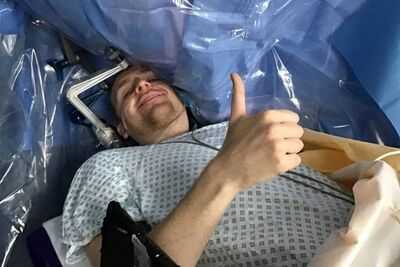
A man who believed he was experiencing "lockdown anxiety" was stunned to discover his "vision loss and dizziness" was in fact being caused by something sinister. Ollie Knight, 29, started experiencing vision difficulties and bouts of dizziness in September 2020 that left him "struggling to read".
He couldn't read "small prints" and the back of shampoo bottles, but finally visited the GP several months later when the fitness enthusiast was "forced to sit" during a run after feeling "giddy". Worried, Ollie was referred for cognitive behavioural therapy, where medics suggested it was probably "anxiety" stemming from the effects of lockdown.
However, it wasn't until April 2021 when he experienced a "suspected stroke" that he was rushed to Luton and Dunstable Hospital where a CT scan uncovered a mass the size of a satsuma on Ollie's brain. He was moved to the National Hospital for Neurology and Neurosurgery in Queen Square, London for a craniotomy - the removal of part of the bone from the skull to expose the brain - and was subsequently diagnosed with a grade 2 astrocytoma - a type of cancer that can occur in the brain or spinal cord.
- New warning for some taking drugs like Sertraline, Citalopram and Fluoxetine
- Dr Amir Khan message for people on lansoprazole, omeprazole, or pantoprazole
Ollie began a course of radiotherapy and chemotherapy straight away and "lost" his independence. Since the "devastating" diagnosis, Ollie has experienced multiple seizures and lost his driving licence, which he later regained. Yet determined not to surrender, he is now on anti-seizure medication and is set to marry his partner, Laura, 29, a data analyst, in June 2026.
His mum, Heidi Knight, 57, a translation project manager from St Albans, said: "Ollie has always been sporty and determined. So when we received the diagnosis of grade 2 astrocytoma, it was devastating.
"There was a time when I truly believed I might lose my son either on the operating table or to a life severely limited by damage. Instead, his story has become one of resilience and hope."
Ollie was just 24 and working as a consultant in London when he began noticing subtle-but-worrying symptoms, including vision problems and dizziness. The condition left him "unable to read", but being fit and active he brushed off the signs as stress-related until he nearly collapsed during a run and visited his GP.
Heidi said: "When he mentioned feeling giddy on a run one day and had to sit down, he didn't think much of it. A runner passing by even stopped to check he was okay. Ollie laughed it off and carried on, but looking back, that was the first red flag."
She added: "He started saying his vision would 'go funny' sometimes and he convinced himself it was exhaustion. But then COVID hit and it got worse."
Surgeons successfully removed 80 per cent of the tumour, but three days later he suffered a full tonic-clonic seizure and was subsequently diagnosed with a grade 2 astrocytoma - a cancerous brain tumour with a poor prognosis, where 45 per cent of patients survive for five years or longer. Ollie began anti-seizure medication - alongside radiotherapy and chemotherapy immediately - and he progressively lost his independence.
Heidi said: "I got a phone call from his fianceé and she was in an ambulance with Ollie. Doctors thought he might be having a stroke.
"But brain tumours are cruel like that, the symptoms are often so ordinary. It was devastating.
"Because of COVID, me and my husband [Roger] couldn't even sit with him the night before. So instead, we chatted on Zoom."
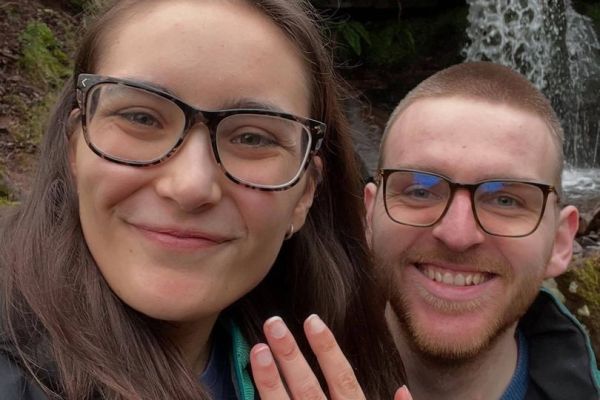
She added: "Ollie went through radiotherapy and chemotherapy. He lost some of his hair, which was hard for someone so young and active, but he handled it with quiet strength. Ollie did not let the tumour define him."
Following his diagnosis, Ollie has experienced multiple seizures, but he has gone on to complete a master's degree in Sports Performance Analysis at the University of Gloucestershire and achieved the highest grade. Currently, he is employed by English Heritage as a business intelligence executive and is now seizure-free, preparing to wed Laura in June this year.
In tribute to her son, Heidi is taking on a 13.1-mile walk at the Bath Ultra Challenge to raise money for Brain Tumour Research on Saturday, March 28. The event forms part of a nationwide drive to raise awareness of a devastating illness that impacts thousands of families throughout the UK.
"Ollie is still living with a brain tumour, but it has not stopped him living a full, meaningful life," Heidi said. "I'm walking the Ultra challenge around Bath.
"I've previously walked 50k with Ollie and Laura and together we raised £2,000, but this challenge feels different; I am doing this on my own. It's about giving back, raising awareness and funding research so outcomes improve."

Letty Greenfield, community fundraising manager at Brain Tumour Research, said: "We are incredibly grateful to Heidi for taking on the Bath Ultra Challenge during Brain Tumour Awareness Month. Stories like Ollie's remind us why our work is so vital. Brain tumours remain underfunded compared to other cancers, yet they devastate so many families. Supporters like Heidi are helping us to give hope to everyone affected by this disease."
To back Heidi's fundraising campaign, visit her dedicated fundraising page.
Contact to : xlf550402@gmail.com
Copyright © boyuanhulian 2020 - 2023. All Right Reserved.