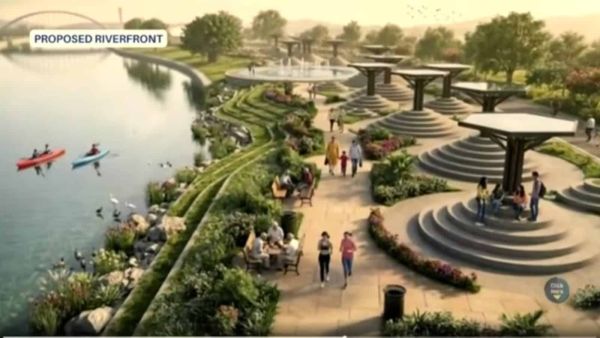
Hyderabad: The Musi Jan Andolan (MJA), a collective of civil society organisations, on Saturday, March 14, issued a point-by-point rebuttal of the Musi Riverfront Development Project’s Phase 1 Detailed Project Report (DPR), alleging that the project’s real objective may be to supply water to data centres being set up in Hyderabad rather than to rejuvenate the river.
Addressing media persons a day after Chief Minister A Revanth Reddy unveiled the DPR at Hotel Taj Krishna in Hyderabad, MJA flagged what it called a “Freudian slip” in his speech, noting that the CM had in the same address spoken of a serious groundwater crisis facing the city and then remarked on how the Musi project would enable a continuous water supply to global data centres.
“In one breath, the Chief Minister poignantly pointed out that the city is facing a serious groundwater crisis. In the very next breath, he remarked how water is required for global data centres and how the Musi project will enable these data centres with continuous supply of water,” the collective said.

MJA also questioned the proposal to build barrages on the river, arguing that one cannot seek to restore a river to its “natural heritage” while simultaneously “arresting it as if it were a small canal for boating.”
It noted that despite the government’s emphasis on the National River Conservation Plan and the Central Water Commission’s technical guidelines on flood plain xoning of July 2025, it was missing a crucial point that “the river is a living entity.”
Pollution, not infrastructure, is the real problem
On the plan to pump water from the Godavari to Osmansagar, MJA said this was not rejuvenation but a costly, energy-intensive and unsustainable approach that ignored the root cause, that is, pollution. Concrete embankments, it warned, would not control floods but worsen the risk by narrowing the channel, increasing water velocity and eliminating natural floodplains.
The MJA also took aim at the government’s proposal to set up sewage treatment plants (STP) as a solution to the river’s pollution, pointing out that STPs treat only sewage and municipal waste and cannot handle toxic industrial effluents. “Effluent Treatment Plants are needed for treating industrial effluent,” it said, noting that neither the Musi River Front Development Corporation Limited (MRDCL) Managing Director nor the Chief Minister had outlined any strategy to curtail industrial discharge into the river.
Referring to Revanth Reddy’s and senior bureaucrats’ visits to riverfront projects in London, Paris, Singapore and South Korea, MJA said the government appeared to have missed the most basic lesson from those success stories, that rivers like the Thames and the Singapore River were cleaned up only after industrial and municipal pollution was completely stopped first.
Pro-poor claims ring hollow, says MJA
MJA also challenged the Chief Minister’s claims of being pro-poor, recalling the “arbitrary and inhumane demolitions” of over 300 houses in Shankar Nagar, Malakpet and other areas of the Old City in October 2024. “To date, there are pending grievances in Prajavani on incomplete rehabilitation,” it said.
The collective further called out MRDCL for presenting differing estimations of the cost of Phase 1 to the State Environment Impact Assessment Authority, as well as conflicting figures on the number of families potentially affected by displacement.
MJA also noted that Hyderabad’s 1908 floods had led to the building of reservoirs for a reason, and that modern best practices favoured wetlands, retention areas and preserved floodplains, not concrete-heavy riverfronts that intensify climate change, urban heat, destroy vegetation and reduce groundwater recharge.
Gandhi, secularism and ‘symbolic’ religion
The collective also criticised the government for invoking Mahatma Gandhi to justify an ecologically unwise and financially extravagant project. “Gandhi did not believe in exorbitance and extravagance, whereas the proposed Gandhi Sarovar and Musi Riverfront are premised on lavish infrastructure that would come at huge social and ecological costs,” MJA said.
It also expressed strong objection to MRDCL’s framing of secularism as a justification for building a temple, church, mosque and gurudwara on the riverbanks. “Displacement and imprudent financial investment shouldn’t be the heavy price for such symbolic secularism,” it said.
MJA called for an overall review of the project and a comprehensive assessment of its social, ecological and financial costs.
Contact to : xlf550402@gmail.com
Copyright © boyuanhulian 2020 - 2023. All Right Reserved.