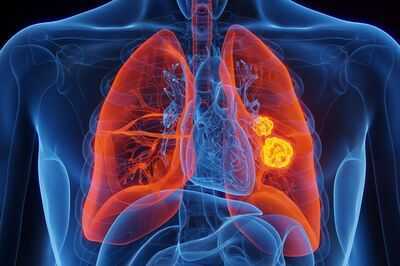
People who have had Covid could be at greater risk of developing one form of cancer, according to a new study. Findings suggest that those who had severe Covid-19 had a 24 per cent higher risk of developing the disease.
Researcher said the increased risk of getting lung cancer was found to be the case even after accounting for smokingand other known risk factors. Scientists also discovered that being vaccinated against Covid and flu could help lower the risk of getting the disease in mice.
As part of the study, which was published in the journal Cell, researchers analysed health records from nearly 76 million American adults. Through this they found that people hospitalised with severe COVID-19 had roughly a 24 per cent higher risk of subsequently developing lung cancer compared to people who had never been infected.
- New warning for some taking drugs like Sertraline, Citalopram and Fluoxetine
- Cold hands and feet could be sign your body is not having enough of 1 thing
To further investigate the potential link between Covid and lung cancer the researchers infected mice with either SARS-CoV-2 or influenza A. They allowed them to fully recover, and then introduced lung tumour cells.
As reported by Study Finds, previously infected animals consistently developed larger, faster-growing tumours and died earlier than mice that had never been infected. The pro-tumour effect from influenza was still found four months after the initial infection.
Utilising a method that identifies which DNA regions are activated or deactivated, the researchers discovered that severe respiratory infections caused lasting alterations in various lung cell types, including immune cells, structural cells, and the cells lining the airways. These changes led to the lungs continuing to overproduce a protein known as G-CSF well after recovery.
G-CSF is a signal that attracts neutrophils, white blood cells that typically arrive during an infection, perform their function, and then leave. In the lung following a viral infection, a specific group of neutrophils gathered in large quantities and remained. Instead of safeguarding the host, they inhibited anti-tumour immune responses and facilitated tumour cell growth.
VaccinesIn another test, mice that received a SARS-CoV-2 mRNA spike vaccine prior to virus exposure were completely shielded from severe illness. When these vaccinated animals were later exposed to tumour cells, they exhibited significantly lower tumour loads than unvaccinated animals that had undergone full infection. A similar experiment using an inactivated influenza vaccine yielded the same outcome.
The severity of infection proved significant even amongst unvaccinated animals. Mice given small amounts of either virus, sufficient to trigger only mild illness, did not demonstrate a notable rise in tumour burden.
It was serious infection, the type involving substantial lung inflammation, which prompted the reprogramming. Vaccines, within these studies, seemed to prevent not only the immediate sickness but also the cancer-related effects that came afterwards.
Study authors wrote: “The Covid-19 pandemic has highlighted the long-term consequences of viral pneumonia, yet its impact on cancer development remains unclear. Here, we show that patients previously hospitalised with severe Covid-19 have an increased risk of subsequent lung cancer. Across multiple murine models, severe respiratory viral infections accelerated lung cancer growth, whereas vaccination mitigated infection-enhanced tumour progression.”
Study limitationsHowever, it is important to note that there are limitations to this study. The human data in this study is retrospective, meaning researchers analysed existing health records rather than following patients prospectively in a controlled trial.
It also cannot be ruled out that people who developed severe Covid-19 may have already have had undetected precancerous changes that contributed both to disease severity and to subsequent cancer diagnosis.
Contact to : xlf550402@gmail.com
Copyright © boyuanhulian 2020 - 2023. All Right Reserved.