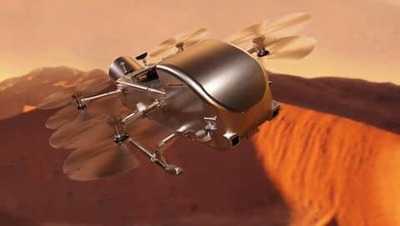
Dragonfly looks like a giant drone, about the size of a small car, with eight rotors that let it "hop" across Titan's surface.
It can fly several kilometers per flight (planned roughly 8km per hop) and is expected to be able to travel up to about 175km over the course of the mission and stay in the air for around 30 minutes per flight.
Packed with cameras, sensors, and even a drill, it's designed to search for signs of life and study what makes Titan so unique.
After descending under a heat shield and parachutes, and protected by thermal insulation once on the surface (it's minus 185 degrees Celsius there!), Dragonfly will explore craters and dunes all on its own.
After arriving in 2034, it'll look for clues about life's building blocks, check out "Titanquakes," and study the alien weather, all powered by nuclear energy so it can survive the extreme cold.
Unlike Mars's tiny solar-powered Ingenuity helicopter (which was about the size of a tissue box), Dragonfly is much bigger, runs on nuclear power, and can visit multiple sites over several years, making it NASA's boldest flying mission yet.
Contact to : xlf550402@gmail.com
Copyright © boyuanhulian 2020 - 2023. All Right Reserved.