
Last Friday, Razorpay cofounder CEO Harshil Mathur hosted a meetup of founders which saw a turnout of around 150 people. While the IPO-bound Razorpay’s core business is providing payment gateway and banking infrastructure to businesses, this gathering at the company headquarters in the startup corridor of Koramangala suburb in Bangalore had nothing to do with fintech.
It was about the open source agentic AI platform OpenClaw that has caught the fancy of a large section of founders. This autonomous personal AI assistant boasts of managing their emails and calendars, book appointments and even fill forms.
Founders’ friend
Mathur is one among those who has passionately adopted OpenClaw in the past few weeks. Just as Mathur did, OpenClaw enthusiasts in several pockets of India’s prominent startup hubs are organising meetups and buildathons — excited about the possibilities that this AI platform has opened up. Some say there is a mad rush to adopt OpenClaw.
Take the case of Mathur, he has connected OpenClaw to email, and fitness tracker. The AI agent now prepares his morning briefing by looking at his calendar, “It even tracks on my friends birthday, suggests what gifts to buy and even places an order on my behalf since I have given access to my credit card with a spending limit,” he told ET.
About the OpenClaw demo he hosted, Mathur said “I wanted to see what other people are doing with it.” Sandeep Kohli, founder, Divyam.ai, built an app to analyse his father’s condition after he suffered a stroke. “But this setup was not communicating it to me. So I used OpenClaw and integrated it into my WhatsApp to send me updates throughout the day,” he told ET.
If Mathur and Kohli are using OpenClaw to automate tasks, developers are building businesses on top of the platform. Bhanu Teja P has built MissionControlHQ, which has 10 OpenClaw agents that can work 24/7 without human intervention. Teja in a post on X has said that he uses these agents to run his other startup SiteGPT.
Global trend
The fast adoption of OpenClaw is a global trend. Y-Combinator startups are building tools on top of the platform. For instance, a YC firm Tensol.ai deploys AI employees, powered by OpenClaw, that runs through the day. Another YC firm Klaus offers to set up OpenClaw on the cloud in three minutes. There is a reason why security pitfalls associated with the platform haven’t really dented the popularity of OpenClaw.
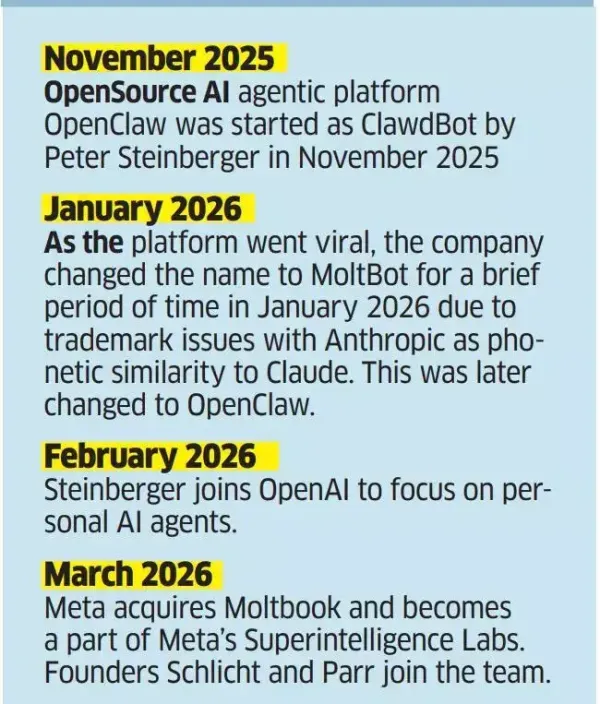
Similar to how ChatGPT made AI more accessible, OpenClaw, while built for technical folks, has showcased what AI agents could possibly do, not just for organisations but also for individuals and smaller startups. Within three months of launching OpenClaw as a hobby project, its creator Austria-based Peter Steinberger, joined OpenAI.
He was hired last month to lead the firm’s work on personal agents. Moltbook, a Reddit-like social media platform for AI agents built on the OpenClaw framework, was acquired by Meta.
BEhind the virality
Unlike the AI agents that run on cloud, OpenClaw AI agents run on the local device, be it your laptop or personal computer. By giving these agents access to your email, WhatsApp or fitness tracker, individuals can automate their fitness regime, prepare meal plans, meeting briefing and a wide range of complex tasks. This unlocking of capabilities made OpenClaw popular with developers.
Prasanna Krishnamoorthy, managing partner, Upekkha, an AI accelerator programme, said, “For the past one year, people have been talking about autonomous AI agents but this is the first time you are seeing an AI agent in action, where you can connect your applications and let the bots do the work throughout the day.”
He explained that earlier agents were able to do only one thing at a time and with OpenClaw, the AI agents are able to run all the time. The experience of Udayan Walvekar, co-founder & CEO, GrowthX illustrates the point. The company’s engineers have created eight AI engineers working under them by combining OpenClaw with Claude Code.
“A quarter’s worth of features, shipped in one week. We already had agents running across onboarding, events, learning, and member matchmaking. OpenClaw took the velocity to a different level,” he told ET.
The experience of Udayan Walvekar, cofounder & CEO, GrowthX illustrates the point. The company’s engineers have created eight AI engineers working under them by combining OpenClaw with Claude Code. “A quarter’s worth of features, shipped in one week. We already had agents running across onboarding, events, learning, and member matchmaking. OpenClaw took the velocity to a different level,” he told ET.
Shashank Agarwal, cofounder of Noveum.ai, said that OpenClaw bots can modify their own instructions and memory, allowing them to improve how they perform tasks over time. Unlike traditional LLM systems that rely on repeatedly sending context as tokens. OpenClaw allows agents to retain and build on memory more efficiently as they operate, he added. This characteristic makes these bots proactive and autonomous, driving startups to build on top of OpenClaw.
Security concerns
OpenClaw has indeed amazed founders with its potential, but it could also be a security nightmare. Early in March, Summer Yue, who is part of Meta’s Superintelligence team, saw her email inbox being deleted by OpenClaw when she had specifically instructed the bot to seek permission before taking action.
In a post on X, she said that she could not stop OpenClaw agents from deleting her inbox from her phone and had to switch off the system.
Several people have flagged that security is one of the key concerns with OpenClaw. Multiple developers have stayed away from it. At least two developers ET spoke to said that they are not experimenting with the platform owing to security issues.
Krishnamoorthy, who was cited earlier, said that he uses Claude Code for most of his work. While OpenClaw is interesting, he had not tried it owing to security issues.
Divyam’s Kohli agreed that this is a key concern and one of the reasons why he operated OpenClaw in a separate virtual machine with limited access to his applications. Noveum’s Agarwal said that OpenClaw’s ability to modify its own instructions that made it better, is also a pitfall. “It means that someone can hack and prompt it to change its behaviour,” he said.
Due to these concerns, the Chinese government has restricted the use of OpenClaw in state-run companies and financial institutions.
It was about the open source agentic AI platform OpenClaw that has caught the fancy of a large section of founders. This autonomous personal AI assistant boasts of managing their emails and calendars, book appointments and even fill forms.
Founders’ friend
Mathur is one among those who has passionately adopted OpenClaw in the past few weeks. Just as Mathur did, OpenClaw enthusiasts in several pockets of India’s prominent startup hubs are organising meetups and buildathons — excited about the possibilities that this AI platform has opened up. Some say there is a mad rush to adopt OpenClaw.
Take the case of Mathur, he has connected OpenClaw to email, and fitness tracker. The AI agent now prepares his morning briefing by looking at his calendar, “It even tracks on my friends birthday, suggests what gifts to buy and even places an order on my behalf since I have given access to my credit card with a spending limit,” he told ET.
About the OpenClaw demo he hosted, Mathur said “I wanted to see what other people are doing with it.” Sandeep Kohli, founder, Divyam.ai, built an app to analyse his father’s condition after he suffered a stroke. “But this setup was not communicating it to me. So I used OpenClaw and integrated it into my WhatsApp to send me updates throughout the day,” he told ET.
If Mathur and Kohli are using OpenClaw to automate tasks, developers are building businesses on top of the platform. Bhanu Teja P has built MissionControlHQ, which has 10 OpenClaw agents that can work 24/7 without human intervention. Teja in a post on X has said that he uses these agents to run his other startup SiteGPT.
Global trend
The fast adoption of OpenClaw is a global trend. Y-Combinator startups are building tools on top of the platform. For instance, a YC firm Tensol.ai deploys AI employees, powered by OpenClaw, that runs through the day. Another YC firm Klaus offers to set up OpenClaw on the cloud in three minutes. There is a reason why security pitfalls associated with the platform haven’t really dented the popularity of OpenClaw.
Similar to how ChatGPT made AI more accessible, OpenClaw, while built for technical folks, has showcased what AI agents could possibly do, not just for organisations but also for individuals and smaller startups. Within three months of launching OpenClaw as a hobby project, its creator Austria-based Peter Steinberger, joined OpenAI.
He was hired last month to lead the firm’s work on personal agents. Moltbook, a Reddit-like social media platform for AI agents built on the OpenClaw framework, was acquired by Meta.
BEhind the virality
Unlike the AI agents that run on cloud, OpenClaw AI agents run on the local device, be it your laptop or personal computer. By giving these agents access to your email, WhatsApp or fitness tracker, individuals can automate their fitness regime, prepare meal plans, meeting briefing and a wide range of complex tasks. This unlocking of capabilities made OpenClaw popular with developers.
Prasanna Krishnamoorthy, managing partner, Upekkha, an AI accelerator programme, said, “For the past one year, people have been talking about autonomous AI agents but this is the first time you are seeing an AI agent in action, where you can connect your applications and let the bots do the work throughout the day.”
He explained that earlier agents were able to do only one thing at a time and with OpenClaw, the AI agents are able to run all the time. The experience of Udayan Walvekar, co-founder & CEO, GrowthX illustrates the point. The company’s engineers have created eight AI engineers working under them by combining OpenClaw with Claude Code.
“A quarter’s worth of features, shipped in one week. We already had agents running across onboarding, events, learning, and member matchmaking. OpenClaw took the velocity to a different level,” he told ET.
The experience of Udayan Walvekar, cofounder & CEO, GrowthX illustrates the point. The company’s engineers have created eight AI engineers working under them by combining OpenClaw with Claude Code. “A quarter’s worth of features, shipped in one week. We already had agents running across onboarding, events, learning, and member matchmaking. OpenClaw took the velocity to a different level,” he told ET.
Shashank Agarwal, cofounder of Noveum.ai, said that OpenClaw bots can modify their own instructions and memory, allowing them to improve how they perform tasks over time. Unlike traditional LLM systems that rely on repeatedly sending context as tokens. OpenClaw allows agents to retain and build on memory more efficiently as they operate, he added. This characteristic makes these bots proactive and autonomous, driving startups to build on top of OpenClaw.
Security concerns
OpenClaw has indeed amazed founders with its potential, but it could also be a security nightmare. Early in March, Summer Yue, who is part of Meta’s Superintelligence team, saw her email inbox being deleted by OpenClaw when she had specifically instructed the bot to seek permission before taking action.
In a post on X, she said that she could not stop OpenClaw agents from deleting her inbox from her phone and had to switch off the system.
Several people have flagged that security is one of the key concerns with OpenClaw. Multiple developers have stayed away from it. At least two developers ET spoke to said that they are not experimenting with the platform owing to security issues.
Krishnamoorthy, who was cited earlier, said that he uses Claude Code for most of his work. While OpenClaw is interesting, he had not tried it owing to security issues.
Divyam’s Kohli agreed that this is a key concern and one of the reasons why he operated OpenClaw in a separate virtual machine with limited access to his applications. Noveum’s Agarwal said that OpenClaw’s ability to modify its own instructions that made it better, is also a pitfall. “It means that someone can hack and prompt it to change its behaviour,” he said.
Due to these concerns, the Chinese government has restricted the use of OpenClaw in state-run companies and financial institutions.