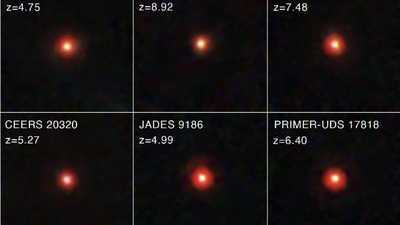
Why do images taken by JSWT have little red dots?
18 Mar 2026
The James Webb Space Telescope (JWST), the most powerful space observatory ever built, has been capturing stunning images of the universe for four years.
However, a peculiar phenomenon has been observed in nearly every image it takes: small, bright red dots.
These cosmic anomalies are known as little red dots (LRDs), but their exact nature remains a mystery.
LRDs have been detected in every JWST image
Unresolved mystery
Since JWST began its observations, hundreds of these strange objects have been detected. Their unknown origins have sparked a scientific investigation that has fueled countless studies.
Jenny Greene, an astrophysical sciences professor at Princeton University, said, "This is the first time in my career that I have studied an object where we truly do not understand why it looks the way it does."
What are LRDs?
Evolving hypotheses
Initially, some astronomers speculated that these dots could be massive galaxies from the early universe or black holes surrounded by dust.
However, these theories were later disproved by further observations.
Greene said she believes a black hole is at the heart of LRDs because it fits most of the observations made so far. But she also cautioned that new data could overturn all existing assumptions about LRDs.
How did LRDs get their name?
Terminology
The term 'little red dots' was first used in a 2024 study, nearly two years after scientists started studying these objects.
It was coined by Jorryt Matthee, head of the research group on galaxy astrophysics at the Institute of Science and Technology, Austria.
He chose it because it was simpler and catchier than the more scientifically accurate term: "broad-line H-alpha emitters."
Why could Webb see them but not Hubble?
Technological advantage
Other telescopes, like Hubble, couldn't detect LRDs due to their lack of resolution or sensitivity in longer infrared wavelengths.
But Webb's 6.5-meter-wide primary mirror has uncovered previously hidden objects.
The dots appear red because they are so far away and the light from distant objects gets stretched into the infrared as it travels to Earth, a phenomenon known as "redshift."
Why are they red?
Color mystery
The inherent redness of the dots is still a puzzle. Matthee initially thought they were growing black holes surrounded by dust particles, but now believes they are red due to hydrogen gas.
Finding more local LRDs could unlock secrets
Cosmic significance
LRDs are common in the early universe but rare in the later universe.
Last year, a team found three LRDs much closer to Earth for the first time. These local LRDs might be 100,000 times rarer than their distant counterparts.
Matthee believes that if more local LRDs are found, they could reveal more secrets about these cosmic anomalies.
Contact to : xlf550402@gmail.com
Copyright © boyuanhulian 2020 - 2023. All Right Reserved.