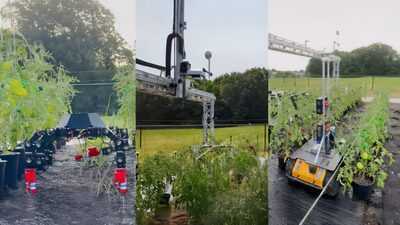
Three robots operate in a test field of tomato plants. Zhen Tan, a computer science doctoral student in the School of Computing and Augmented Intelligence, part of the Ira A. Fulton Schools of Engineering at Arizona State University, has received a 2026 Rising Star Award from the Conference on Parsimony and Learning for his artificial intelligence research that has applications in agriculture and health care. Photo illustration by Erika Gronek/ASU; photos courtesy of Zhen Tan.
By Kelly deVos
Newswise — Somewhere, a patient is staring at a screen, asking a chatbot which medication is safe, hoping it remembers the allergy she mentioned months ago.
Elsewhere, a farmer surveys his fields at dawn, imagining a future where robots scan for disease, target weeds and boost yields — but he wonders how on earth he’s supposed to tell a machine what to do.
In both cases, the promise of artificial intelligence, or AI, is tantalizing. But questions linger. Can we trust AI? Can we understand it? How can we best use it?
According to Arizona State University computer science doctoral student Zhen Tan, the answer is: Yes — with systems that are not only powerful but parsimonious.
Tan, who is studying in the School of Computing and Augmented Intelligence at Arizona State University, has been named a recipient of a 2026 Rising Star Award from the Conference on Parsimony and Learning for his research agenda tackling one of the most urgent problems in AI: how to make complex models understandable — and therefore usable — by real people.
From black box to glass boxTan’s work centers on explainable AI.
“My work tries to bridge the gap between ordinary people and their understanding of AI systems,” he says. “It’s about designing systems that are simpler, more efficient and more transparent from the start.”
That’s where parsimony comes in. In machine learning, parsimony means building systems that rely only on what is essential. Instead of using every part of a massive model for every task, a parsimonious system activates the components that truly matter.
For Tan, this isn’t just about saving computing power; it’s about clarity. When a model uses fewer moving parts, researchers can more easily trace how it reaches a decision. That makes systems not only more efficient and practical to deploy, but also easier to interpret, debug and ultimately trust in real-world settings.
That interpretability becomes crucial in high-stakes domains like health care.
Imagine an AI system trained on images of human tissue, tasked with predicting a donor’s age or identifying disease markers.
“If you just tell the doctor that, based on the image, the donor’s age is 60, the doctor will ask, ‘Should I trust this prediction or not?’” Tan says. “So instead of just giving the final number, we show which features of the cell are driving that prediction, whether it’s the shape of a structure or its size.”
That same philosophy — AI as collaborator rather than oracle — shaped Tan’s internship at Google Research, where he worked on long-term memory for conversational agents. If you tell an AI you are allergic to a drug, it should not ask you again next week. It should be remembered.
Tan helped build systems that retain and retrieve the right details at the right moment, allowing AI assistants to adapt over time instead of resetting with every conversation. In settings like medicine, that continuity is more than personalization — it’s protection.
Robots in the rowsIf health care reveals the stakes of explanation, agriculture reveals its scope.
In another project, Tan collaborated with robotics and agriculture researchers to build an AI agent that acts as a translator between farmers and machines. A farmer can issue a simple, high-level instruction in plain language, such as asking the system to find and treat diseased plants. The AI agent then breaks that request into coordinated actions carried out by a team of robots: a drone performs aerial scans, a ground rover conducts close-up inspections, and a hexapod robot applies targeted treatments.
The communication flows both ways. After surveying the field, the system reports its findings, identifying which plants are infected, the type of disease present and how severe it is. Instead of forcing farmers to interpret raw sensor data or robotic code, the AI summarizes the results in terms they can understand.
Behind the scenes, Tan helped design algorithms trained in a digital twin of the farm, a simulated environment that models shifting light, wind and rain conditions. Once trained virtually, the system’s decision-making strategies are transferred to the real field. The result is a practical partnership: farmers give direction, robots execute with precision and the system explains what it sees along the way.
AI that you can ask why
Regents Professor Huan Liu, a global AI pioneer who is consistently ranked among the world’s top computer scientists and serves as Tan’s advisor, sees in Tan a rare blend of rigor and reach.
“Zhen combines rigorous thinking with a collaborative spirit,” Liu says. “He’s deeply passionate about AI and incredibly hardworking, consistently pushing himself to tackle ambitious problems. He also understands that the hardest challenges require teamwork across disciplines.”
As Tan prepares to defend his dissertation and interview for faculty positions, his ambitions remain firmly rooted in academia. He hopes to become a professor, driven by a desire to push the boundaries of scientific discovery and to train the next generation of researchers.
The throughline of his work — whether in a hospital lab, a server farm or a cornfield — is a refusal to accept black boxes. In a world racing toward ever-larger models and ever-faster outputs, Tan focuses on making complex models more transparent and helping people understand how those systems reach their conclusions.
Somewhere, a patient will one day receive a recommendation that remembers her history. Somewhere else, a farmer will issue a simple command and watch a fleet of robots spring into action. If Tan has his way, both will understand not just what the AI is doing, but why.
Read the original article on ASU News. National Robotics Week is April 4 through 12.
https%3A%2F%2Fwww.newswise.com%2Farticles%2Frising-star-builds-ai-for-clinics-and-crops%2F%3Fsc%3Drsla
The post ‘Rising Star’ Builds AI for Clinics and Crops appeared first on CliQ INDIA.
Contact to : xlf550402@gmail.com
Copyright © boyuanhulian 2020 - 2023. All Right Reserved.