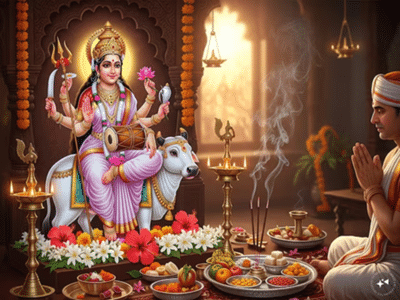
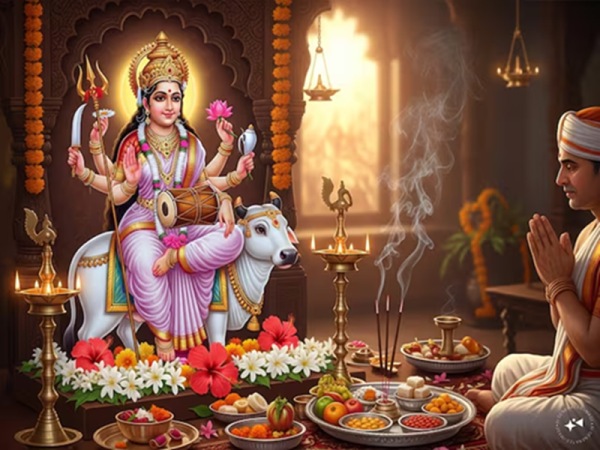
Chaitra Navratri 2026 Day 8: As the eighth day of Chaitra Navratri arrives, the atmosphere within homes undergoes a spontaneous transformation—marked by morning *aarti* (prayers), the aroma of *Bhog* (sacred food offerings) being prepared in the kitchen, and preparations for *Kanya Pujan* (worship of young girls). Today marks *Durgashtami*—a special day dedicated to the worship of Goddess Mahagauri. It is believed that the prayers offered on this day not only bestow peace upon the mind but also gradually resolve the complexities and entanglements of life.

While many view this day merely as a religious tradition, in reality, it is also a day for self-purification and for making new resolutions. The divine form of Goddess Mahagauri symbolizes simplicity, purity, and patience; for this very reason, the impact of her worship is not confined solely to matters of faith but is also reflected in one's lifestyle.
The Significance of Worship and Its Connection to Daily Life
The worship of Goddess Mahagauri is associated not only with religious observance but also with mental equilibrium and positivity. It is said that the prayers offered on this day foster peace and harmony within the home and bring stability to one's marital life.
Rituals for Worshipping Goddess Mahagauri
- Waking up early in the morning and taking a ritual bath is considered the first and most essential step of the day.
- Subsequently, the home temple or prayer altar is cleaned, and an idol or image of Goddess Mahagauri is installed.
- In many families, the tradition of ritually bathing the idol with *Gangajal* (holy water from the Ganges) is still observed today, symbolizing purity.
- The color white holds special significance during the worship rituals.
- White garments are offered to the Goddess, accompanied by white flowers such as *Mogra* or *Chameli* (Jasmine).
- The worship is performed according to prescribed rituals using *Roli* (red vermilion powder), *Kumkum* (sacred red powder), and *Akshat* (unbroken rice grains).
- Finally, *Bhog* (sacred food offerings) consisting of sweets, fruits, and *Panchmeva* (a mixture of five dry fruits) is offered to the Goddess.
The Significance of *Kanya Pujan*
*Kanya Pujan* (the worship of young girls) is considered highly auspicious on the day of *Ashtami*. Nine young girls are worshipped as the living embodiments of Goddess Durga. They are served a meal consisting of *Poori* (fried bread), *Halwa* (sweet pudding), and *Kala Chana* (black chickpeas). In many households, this tradition has been upheld for generations, with all family members joining together to participate in this sacred ritual. **Mother Mahagauri’s Favorite Offerings and Color**
The *Bhog* (sacred food offering) prepared on this day reflects both simplicity and deep reverence. *Halwa-Puri*, black chickpeas (*Kala Chana*), and *Kheer* are specifically offered to the Mother Goddess. The coconut is also considered to be extremely dear to her.
Auspicious Color
White is the auspicious color for this day. Devotees often wear white or light-colored garments, symbolizing peace and positive energy. This color also aids in stabilizing the mind—perhaps this is precisely why it is associated with Mahagauri.
The Spiritual Impact of Mantras and Worship
“Ya Devi Sarvabhuteshu Ma Gauri Rupena Samsthita.
Namastasyai Namastasyai Namastasyai Namo Namah.”
Regular chanting of this mantra evokes a unique sense of tranquility within the mind. Many devotees report that on this day, it becomes remarkably easy to focus during mantra recitation—as if the very atmosphere itself has become imbued with a meditative calm.

The Legend of Mother Mahagauri
According to mythological lore, Mother Parvati undertook rigorous penance to attain Lord Shiva as her husband. Due to the austerity of this penance, which spanned many years, her body turned dark in complexion. However, when Lord Shiva was pleased by her unwavering devotion, he granted the Goddess a boon to bathe in the holy River Ganges. After bathing in the Ganges, her form became radiantly luminous—pure white like milk, serene, and resplendent. From that moment on, she came to be known as ‘Mahagauri.’ This legend is not merely a religious narrative; it also serves as a profound reminder that, even after enduring the most arduous circumstances, light and radiance can indeed return to one's life.
PC Social Media
Contact to : xlf550402@gmail.com
Copyright © boyuanhulian 2020 - 2023. All Right Reserved.