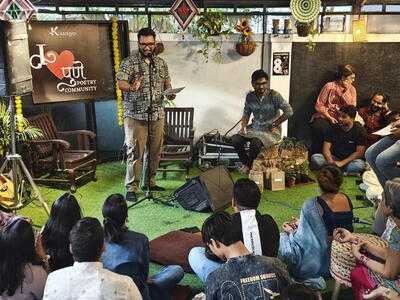
On most days, poetry exists in fragments, scribbled in notebooks, whispered into phone recordings, or performed in dimly lit cafés across the city. But around World Poetry Day , those fragments find a way to gather, and breathe collectively. In Pune, that spirit took shape at “Beyond Open Mic”, a full-day art retreat in Baner that attempted to stretch the idea of an open mic into something far more immersive.
Organised by Kissagoi and Baithak and Beyond , the event was less about fleeting performances and more about building a shared creative ecosystem . As Saad Ahmed Shaikh, founder of Baithak and Beyond, puts it, the intention was to create a space where people “not just perform, but actively network… listen to a variety of voices and learn at the same time.” He adds, “The structure was built for the idea that you come here not only to listen to others, not only to perform, not only to speak, but to actually sit down and think about the art or craft of writing, think about the craft of performing.”
Where art finds a collective voice
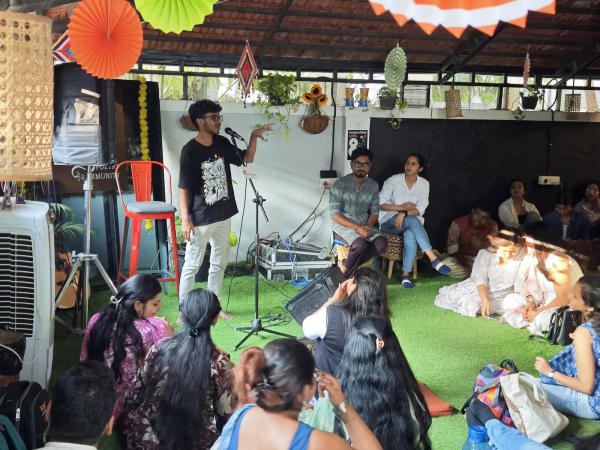
Beginning with introductions and conversations around the culture of open mics, the retreat moved into focused workshops. One on performance by Tushar Padolkar and another on writing led by Shaikh himself. For nearly three hours, participants stayed engaged, absorbing techniques that could refine both craft and confidence. As Simran Khurana, founder of Kissagoi, says, the goal was to get people to “sit down and think about the art… the craft of writing and performing,” rather than just cycle through performances.
By the afternoon, the energy shifted. A shared lunch gave way to guest performances and a slam poetry competition , where participants were pushed to bring their best work, not just for applause but for recognition and prize money. Yet, even within the competitive format, the emphasis remained on community. Khurana describes slam poetry here not as “a competition of envy,” but as something “community-driven,” where artists grow together rather than against each other.
Competition, but with community at its core 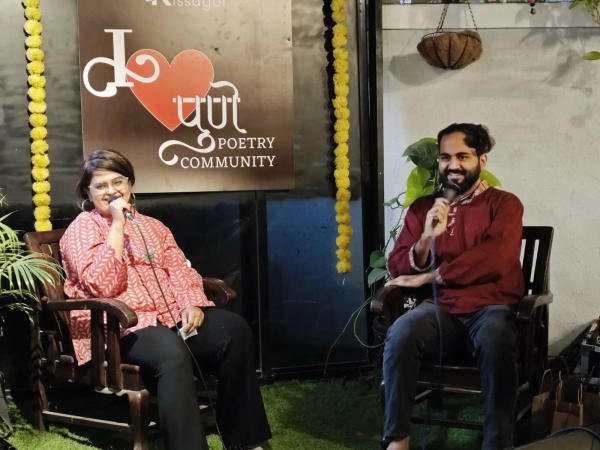
For performers like Saurabh Kathale, an engineer by profession, that sense of community is transformative. Listening to others, he says, offers “different perspectives” that extend beyond poetry into everyday life. More importantly, spaces like these chip away at something deeper: fear. “Performing on smaller stages like Kissagoi and different organisations that are here, it gave me an opportunity to explore myself, to get a little more confident, to understand what is my voice. And I think that is the best thing that can happen to you, performing on multiple platforms every day,” he adds.
Holding such a diverse and emotionally charged space, however, requires careful calibration—something the hosts are acutely aware of. Sannidhi Alka Rao, who helmed the slam segments, emphasises the need to balance structure with sensitivity. “Every performance, the performer is super vulnerable and we make it very clear that this is a safe space and the audience needs to respect each of the performers and respect their pieces. So we make it very clear right from the start and ensure that none of those things happen. And the artist feels safe while performing,” she says.
More than an event, a growing movement
As the evening unfolded with community-led segments, interactive quizzes, and friendly competitive debates, the event began to resemble less of a programme and more of a network. One that extended beyond the stage, beyond the schedule, and perhaps most importantly, beyond the idea of a conventional open mic.
In many ways, ‘Beyond Open Mic’ mirrors the evolving identity of poetry itself. No longer confined to solitary expression or sporadic gatherings, it is increasingly collaborative, performative, and community-driven.
Contact to : xlf550402@gmail.com
Copyright © boyuanhulian 2020 - 2023. All Right Reserved.