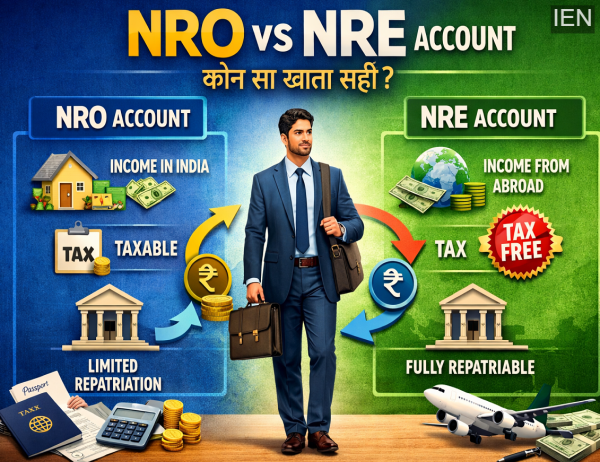
For Indians living or working abroad, managing finances in India requires a different banking setup. Non-Resident Indians (NRIs) cannot continue using regular savings accounts in the same way as resident individuals. Instead, they must opt for specialized accounts designed under FEMA regulations.
Among the available options, NRO (Non-Resident Ordinary) and NRE (Non-Resident External) accounts are the most commonly used. Each serves a different purpose, especially when it comes to taxation, income sources, and money transfers. Understanding the differences can help NRIs avoid unnecessary taxes and ensure smooth fund management.
Who Qualifies as an NRI?
Under the Foreign Exchange Management Act (FEMA), an NRI is an Indian citizen or a Person of Indian Origin (PIO) residing outside India for employment, business, or other purposes.
NRIs can open three types of bank accounts in India:
- NRO Account
- NRE Account
- FCNR Account
Among these, NRO and NRE accounts are the most widely used for day-to-day financial needs.
What Is an NRO Account?
An NRO account is primarily used to manage income earned within India. This includes:
- Rental income
- Dividends
- Pension
- Proceeds from property sales
If a resident Indian becomes an NRI, their existing savings account must be converted into an NRO account.
Key Features of NRO Account:
- Can be opened as savings, current, fixed deposit, or recurring deposit
- Accepts deposits both from India and abroad
- Can be held jointly with a resident Indian or another NRI
- Suitable for managing domestic income
Transfer and Repatriation Rules:
Funds in an NRO account can be transferred abroad, but there is a limit. NRIs can remit up to $1 million per financial year, subject to applicable taxes and documentation.
What Is an NRE Account?
An NRE account is designed for income earned outside India. It allows NRIs to park their foreign earnings in India conveniently.
Key Features of NRE Account:
- Can only be opened by NRIs
- Accepts deposits in foreign currency (converted to INR)
- Fully repatriable—money can be transferred abroad without any limit
- Can be opened as savings, current, or fixed deposit
Additional Benefits:
- Funds can be used for investments in India
- Can be used to pay EMIs, including home loans
- Loans can be availed against deposits in India or abroad
Note: Joint accounts are allowed only with another NRI.
Taxation: The Biggest Difference
One of the most crucial differences between NRO and NRE accounts lies in how they are taxed.
- NRO Account:
- Interest earned is fully taxable in India
- Banks deduct TDS on interest income
- NRE Account:
- Interest earned is completely tax-free in India
- This benefit continues as long as the account holder remains an NRI
Once the individual returns to India and becomes a resident, the tax-free status of the NRE account no longer applies.
Important Transfer Rule You Should Know
You can transfer funds from an NRE account to an NRO account. However, once the money is moved into the NRO account, it loses the benefit of free repatriation.
This means:
- Funds in NRO are subject to transfer limits and taxes
- You should carefully plan before making such transfers
Which Account Should You Choose?
The choice between NRO and NRE depends entirely on your income source:
- Choose NRO Account
If you earn income in India (rent, dividends, pension, etc.) - Choose NRE Account
If your primary income is abroad and you want to transfer and maintain funds in India without tax burden
In many cases, NRIs maintain both accounts to manage different types of income efficiently.
Final Takeaway
NRO and NRE accounts serve distinct purposes and are both essential tools for NRIs managing finances across borders. While the NRO account is ideal for handling Indian income, the NRE account offers tax-free benefits and easy global transfers for foreign earnings.
Choosing the right account—or a combination of both—can help you optimize taxes, simplify transactions, and manage your money more effectively across countries.
Contact to : xlf550402@gmail.com
Copyright © boyuanhulian 2020 - 2023. All Right Reserved.