
New Delhi: The government has asked banks to work with the National Payments Corporation of India (NPCI) to curb high Unified Payments Interface (UPI) transaction failures, as glitches and user errors threaten to dent confidence in the country’s fastest-growing payments network.
NPCI is expected to review lenders’ performance and suggest measures to improve success rates, said people familiar with the matter. The discussions, held over the past two months, are part of a broader government push to strengthen the digital payments ecosystem, said the people, who did not wish to be identified. Queries emailed to NPCI did not elicit a response till press time.
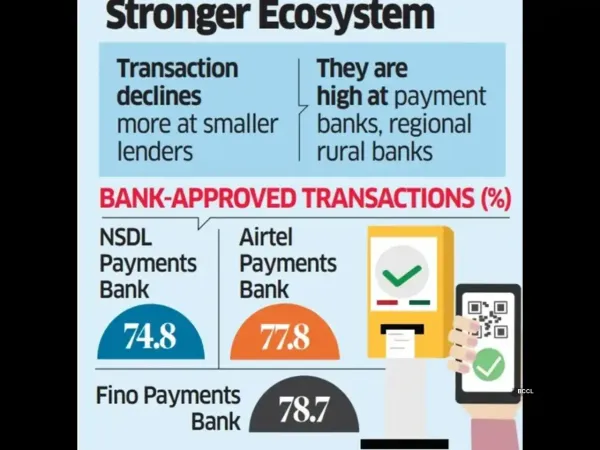
Transaction declines have been particularly high at smaller lenders, including regional rural banks, where weaker technology infrastructure and customer awareness gaps have amplified failures. “Higher failure rates can deter users from adopting digital payments,” said a government official.
 Improving Reliability
A transaction may fail due to technical issues such as system outages or network disruptions at banks or NPCI, or due to business reasons, including incorrect personal identification number (PIN) entry or transaction limits being breached. Among the top 50 UPI members, Airtel Payments Bank recorded the highest business decline failure in February, at 21.97%, while Baroda UP Bank saw the highest technical decline, at 7.26%, according to the latest available data.
The issue has also been compounded by periodic outages. NPCI reported downtime across 11 banks in February, with Bank of India logging the highest at about 14 hours. “We will assess whether these failures are largely technical or if there is a need for greater customer awareness,” said a senior executive at a state-run bank. “Transaction declines don’t bode well for any stakeholder in the ecosystem.”
The push to improve reliability comes as UPI cements its dominance in India’s payments landscape. Finance minister Nirmala Sitharaman recently told the Parliament that UPI accounted for 81% of all retail digital payments in FY25, making it the world’s largest real-time retail payments system.
To deepen adoption, especially in rural and semi-urban areas, the Reserve Bank of India has backed the roll-out of infrastructure through the Payments Infrastructure Development Fund. The scheme has enabled the deployment of about 580 million digital touchpoints and nearly 5.7 billion QR codes, Sitharaman said in a written reply. Policymakers are also looking beyond basic transactions. A finance ministry report released at a recent policy review meeting highlighted that the next phase of growth for UPI and RuPay would hinge on value-added services such as micro-credit, insurance and loyalty programmes, which could drive deeper user engagement and financial inclusion.
NPCI is expected to review lenders’ performance and suggest measures to improve success rates, said people familiar with the matter. The discussions, held over the past two months, are part of a broader government push to strengthen the digital payments ecosystem, said the people, who did not wish to be identified. Queries emailed to NPCI did not elicit a response till press time.
Transaction declines have been particularly high at smaller lenders, including regional rural banks, where weaker technology infrastructure and customer awareness gaps have amplified failures. “Higher failure rates can deter users from adopting digital payments,” said a government official.
A transaction may fail due to technical issues such as system outages or network disruptions at banks or NPCI, or due to business reasons, including incorrect personal identification number (PIN) entry or transaction limits being breached. Among the top 50 UPI members, Airtel Payments Bank recorded the highest business decline failure in February, at 21.97%, while Baroda UP Bank saw the highest technical decline, at 7.26%, according to the latest available data.
The issue has also been compounded by periodic outages. NPCI reported downtime across 11 banks in February, with Bank of India logging the highest at about 14 hours. “We will assess whether these failures are largely technical or if there is a need for greater customer awareness,” said a senior executive at a state-run bank. “Transaction declines don’t bode well for any stakeholder in the ecosystem.”
The push to improve reliability comes as UPI cements its dominance in India’s payments landscape. Finance minister Nirmala Sitharaman recently told the Parliament that UPI accounted for 81% of all retail digital payments in FY25, making it the world’s largest real-time retail payments system.
To deepen adoption, especially in rural and semi-urban areas, the Reserve Bank of India has backed the roll-out of infrastructure through the Payments Infrastructure Development Fund. The scheme has enabled the deployment of about 580 million digital touchpoints and nearly 5.7 billion QR codes, Sitharaman said in a written reply. Policymakers are also looking beyond basic transactions. A finance ministry report released at a recent policy review meeting highlighted that the next phase of growth for UPI and RuPay would hinge on value-added services such as micro-credit, insurance and loyalty programmes, which could drive deeper user engagement and financial inclusion.