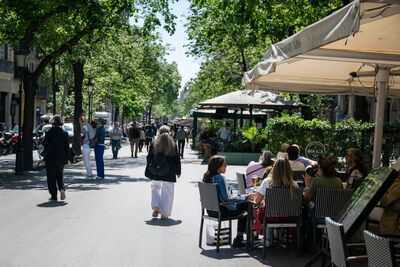
UK travellers to Spain have been told of a ‘doubling’ of a charge for all tourists going to a popular hotspot from today. It has been reported in Spain that the doubling of the municipal surcharge comes into effect on April 1.
Depending on the type of accommodation, tourists may pay up to €15 more per night in Barcelona. This is due to an increase in the tourist tax on the one hand now ranging from €1 to €7 depending on the category of accommodation and a municipal tax which rises from €4 to €8.
Applicable to stays in hotels, hostels and short-term rentals, these taxes can, when combined, amount to up to €15 per night per person, LeFigaro reported.
- Big rise in 'fatal in hours' infection in travellers coming to UK from 4 destinations
- Couple split up at airport after noticing four-letter code on boarding pass
The measure was announced inMarch 2025 but was only approved by the Catalan parliamenta few weeks ago. Barcelona City Council has voted in favour of increasing the council tax by one euro per year until 2029. The aim is to tackle the housing crisis. Residents regularly protest against rising rents, which they believe are partly due to the growing number of short-term rentals such as Airbnb.
In a four-star hotel – which accounts for nearly half of the local hotel stock – a two-night stay for a couple could therefore cost up to €45 more. Cruise ship passengers must also pay these taxes: they will pay €12 - instead of €8 - if they disembark for more than twelve hours, or €14 (instead of €11) if they stay for less than twelve hours. One exception remains for a specific category of accommodation: hostels listed in the Generalitat de Catalunya’s Youth Hostel Register, for which the fee remains at €1.
With these new rules, the Autonomous Community of Catalonia hopes to raise 200 million euros a year. On its website, the Catalan government states that “25% of the revenue from the tourist tax will be allocated to the Generalitat’s housing policies, whilst 75% will be channelled into the Tourism Promotion Fund, [in particular] for housing policies [and] economic development policies.”
With the new regulation, the tax will rise to seven euros per night in five-star accommodations in Barcelona and to 3.40 euros in four-star accommodations. It will also be more expensive for cruise passengers, especially those disembarking in the Catalan capital. Those staying for less than 12 hours will pay six euros in Barcelona and 4.50 euros in the rest of the ports in Catalonia , 20 Minutos reported.
The tax increase will be phased in over two years. The first increase will take place this April, while the remainder will be implemented a year later, in April 2027. At that point, the tourist tax will be completely doubled. However, in Barcelona, the increase will be more immediate and will begin this month to address the high tourist pressure the city experiences, unlike the rest of Catalonia.
The revenue from the tourist tax will be divided into two parts. 25% of the total income will be allocated to housing policies of the Generalitat (Catalan government), one of the main pillars of Catalan President Salvador Illa’s policies. The remaining 75% of the revenue will be integrated into the Tourism Promotion Fund.
The increase in the tourist tax in Catalonia already has the support of a majority of the parliamentary groups, as well as the backing of a large part of the population. This is especially true in Barcelona, where overtourism has wreaked havoc on both housing and community life. In fact, in the Catalan capital, there have already been demonstrations by residents against the massive influx of visitors, and proof of this is that 76.7% of the population says the city has reached its maximum capacity for receiving tourists.
These data are reflected in the latest survey on tourism perception in Barcelona, published by the city council itself, in which 56% of residents support the increase in the tourist surcharge.
Public support for the increase in the tourist tax contrasts sharply with the total opposition from the Catalan tourism sector. Following the announcement of the agreement between the PSC, ERC, and Comuns parties, business owners in Catalonia’s tourist accommodation sector expressed their “total and unanimous rejection.” The employers’ association Confecat asserted that the measure is “improvised, lacking strategic rigour, disconnected from the country’s real needs, and driven solely by revenue collection.”
Furthermore, the Catalan Federation of Tourist Apartments (Federatur) warned that the tax increase will lead to a loss of competitiveness for the region and make Catalans’ holidays more expensive. This position is also supported by other employers’ associations, trade groups, and federations within the sector, such as Foment del Treball, the Barcelona Hotel Guild, Pimec, and the Barcelona Tourist Apartment Association.
According to Jordi Clos, president of the Hotel Association, there is some concern among representatives of the tourism sector about how the tax increase will affect business. “It will be necessary to monitor the impact this measure may have to prevent a significant and lasting decline,” he stated after the Catalan Parliament approved the increase in February.
Contact to : xlf550402@gmail.com
Copyright © boyuanhulian 2020 - 2023. All Right Reserved.