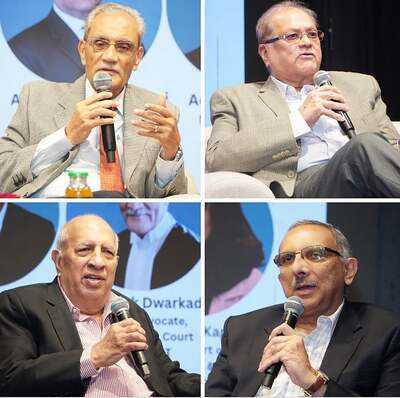
If you thought arbitration was just another sleepy procedural subject tucked somewhere between CPC and Evidence, the flagship panel discussion at D.M. Harish School of Law, HSNC University, would have changed your mind.
The convocation hall at HSNC University was buzzing, not with the nervous energy of mooters or the polite applause of a routine seminar, but with the kind of sharp, unfiltered conversation you don’t usually hear inside law school walls. The theme sounded textbook enough: “The Practical Aspects and Pitfalls of Arbitration in India and the Way Forward.” But what followed was anything but predictable.
On stage sat some of the most experienced arbitration practitioners in the country, Mr. Hiroo Advani, Senior Partner, Bharucha & Partners; Mr. Janak Dwarkadas, Senior Advocate, Bombay High Court; Mr. Haresh Jagtiani, Senior Advocate, Bombay High Court and Mr. Anand Desai, Managing Partner, DSK Legal, with Dr. Dhruti Kapadia, Advocate-on-Record at the Supreme Court of India, moderating the discussion with precision and ease. It felt like listening in on a strategy session about India’s commercial future viewed through the lens of arbitration. The panel discussion was graced by Mr. Anil Harish, Provost, HSNC University, Mumbai & Partner, D.M. Harish & Co.
For Mr. Hiroo Advani, the panel felt like a coming home. He fondly recalled that his grandfather, Shri Hotchand Advani, was the founder trustee, HSNC Board and had served as its President for over 40 years, reflecting a deep personal connection to the institution and adding a heartfelt, generational touch to the otherwise intensely professional discussion on arbitration.
The session also reflected a broader shift at D.M. Harish School of Law, which, in recent years, has been steadily building a reputation for convening conversations that bridge academic inquiry with real-world legal practice. Recent moves, including the appointment of former Bombay High Court judge Justice Gautam Patel as Professor of Practice, suggest an effort to bring frontline experience more directly into the classroom and encouraging practitioners and students to engage on equal intellectual footing.
At the outset, the panel acknowledged the larger reality, India’s courts are carrying an enormous burden, with a dismal judge to population ratio, over 63 lakh cases pending in high courts and judges often dealing with 50+ matters in a single day’s board. Mr. Haresh Jagtiani even referred to a matter originating in 1947 that was only recently resolved in the Bombay High Court, a telling illustration of systemic delay. It is precisely within this context that arbitration has gained significance, not as a luxury, but as a necessary complement to an overburdened judicial system.
The panel emphasised that the true intent of arbitration is to provide efficient, impartial and commercially sensible dispute resolution for all stakeholders, parties, lawyers and arbitrators alike. It is meant to reduce delays, minimise litigation costs and ensure that disputes are resolved with finality, while preserving autonomy and fairness for everyone involved.
At the heart of the conversation was a paradox. India’s arbitration law, the Arbitration and Conciliation Act, 1996, is modern, globally aligned and repeatedly amended to signal reform. The Supreme Court has delivered landmark decisions like Bharat Aluminium Co. v. Kaiser Aluminium and Associate Builders v. DDA that tightened judicial intervention and clarified “public policy.” On paper, we are arbitration-friendly. But the panel kept returning to the same uncomfortable question: why does arbitration in India still sometimes feel like litigation in better lighting?
Section 34 of the Act, the provision that allows courts to set aside arbitral awards, hovered over the discussion like a familiar plot twist everyone saw coming. Meant to be limited in scope, these challenges can still prolong disputes, sometimes sending parties back into familiar courtroom battles. For many students in the audience, it was a reality check that arbitration, while faster, does not always guarantee swift finality.
And then came the elephant in the room: the government. As the country’s largest litigant, the State is deeply involved in arbitration, especially in infrastructure and public-private partnership disputes. Yet adverse awards against government entities are frequently challenged. The issue, as hinted during the discussion, is not always legal weakness but institutional hesitancy. Bureaucratic caution, audit pressures and fear of scrutiny make settlement politically harder than contesting. Arbitration reform, it became clear, is also governance reform.
The discussion also flagged the Union Finance Ministry’s recent procurement guidelines as a potential pitfall for arbitration’s growth. By advising that arbitration should not be routinely included in government contracts and generally restricting it to disputes below Rs10 crore, while requiring higher-level approvals for larger claims, the policy risks signalling a certain institutional hesitation towards arbitration in high-value public contracts, potentially undermining confidence in its role as the default mechanism for complex commercial disputes.
Another thread that ran through the session was the credibility gap between India and global arbitration hubs. While domestic institutions such as the Mumbai Centre for International Arbitration and the Delhi International Arbitration Centre are strengthening their frameworks, many India-related disputes are still seated abroad, often at the Singapore International Arbitration Centre (SIAC), Dubai International Arbitration Centre (DIAC), London Court of International Arbitration (LCIA). It’s not necessarily a rejection of Indian law; it’s about perception, administrative efficiency, predictability and international comfort. The panel subtly but clearly conveyed that India must build not just law, but trust.
Nearly 24% of SIAC’s cases involve at least one Indian party, a striking figure that shows how actively Indian companies are participating in international arbitration. Yet it also tells another story: while India is exporting disputes to global hubs like Singapore, many foreign parties still hesitate to choose India as the seat, highlighting the confidence gap that domestic reforms must continue to address.
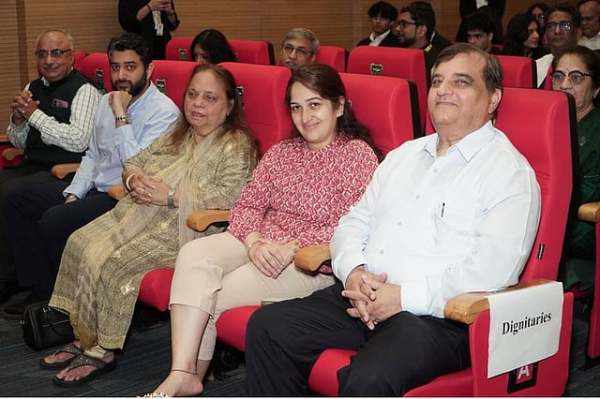 HSNC University, Mumbai Provost Mr. Anil Harish along with Registrar Dr, Bhagwan Balani among those attending the panel discussion
 The panel also briefly discussed Cox & Kings Ltd. v. SAP India Pvt. Ltd., noting how the Supreme Court’s clarification of the “group of companies” doctrine brought greater certainty to the question of binding non-signatories in arbitration.
The discussion around arbitrator appointments added another layer. After the Supreme Court’s ruling in Perkins Eastman Architects v. HSCC, unilateral appointment clauses were effectively curbed, reinforcing neutrality. Yet questions remain about repeat appointments, limited diversity and fee transparency. For a generation that talks openly about representation and fairness, arbitration’s “closed circle” perception is not sustainable. If arbitration is to be the dispute resolution mechanism of a global India, its bench must look like the economy it serves.
What made the session particularly engaging was its honesty about culture. India does not necessarily need a dozen more amendments. It needs behavioural change. Arbitrators must manage cases actively. Lawyers must resist turning arbitration into mini-trials. Government departments must stop treating every adverse award as an institutional defeat. The law can only do so much; mindset carries the rest.
Technology also crept into the conversation, not as a buzzword but as a practical shift. Virtual hearings, normalised during the pandemic, have reduced logistical delays. The future may see AI-assisted document review, digital evidence platforms and more streamlined procedures in complex construction, infrastructure, telecom and energy disputes. Arbitration, once seen as old-school and paper-heavy, may well become one of the most tech-integrated fields in commercial law.
By the end of the panel discussion, what lingered wasn’t just doctrinal clarity but a sense of urgency. Arbitration is no longer an “alternative” mechanism; it is central to India’s economic positioning. Foreign investors care less about how beautifully a statute is drafted and more about how predictably disputes are resolved. Enforcement, speed, neutrality, these are not abstract ideals; they are competitive advantages.
For the law students in attendance, the conversation landed differently. Arbitration is not just a chapter in the syllabus or a moot court theme. It is a field where litigation instincts meet international strategy, where policy intersects with practice and where India’s global ambitions are quietly tested. The future of arbitration will be shaped by young lawyers who decide whether to replicate procedural excesses or build something leaner and smarter.
If there was one takeaway from the day, it was this: arbitration in India stands at a turning point. The framework exists. The judiciary has signalled restraint. Institutions are emerging. What remains is alignment between law, practice and culture. And if that alignment happens, arbitration will not just resolve disputes, it will quietly power India’s next phase of growth.
Contact to : xlf550402@gmail.com
Copyright © boyuanhulian 2020 - 2023. All Right Reserved.