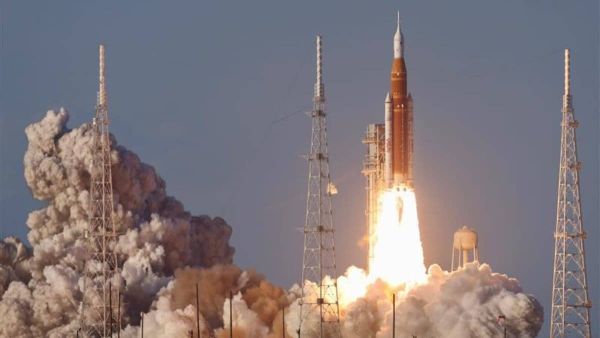
In a moment that echoed the golden age of space exploration, four astronauts lifted off aboard NASA’s Artemis II mission, embarking on humanity’s first journey toward the Moon in more than half a century.
The towering 32-story Space Launch System rocket thundered into the early evening sky from Kennedy Space Center in Florida, carrying astronauts Reid Wiseman, Victor Glover, Christina Koch and Jeremy Hansen on a historic 10-day mission around the Moon and back on Home Earth.
Tens of thousands gathered at the launch site, with crowds spilling onto nearby roads and beaches - scenes tending to make one think of the Apollo moon missions of the 1960s and 1970s. As the engines ignited and flames lit up the launch pad, cheers erupted, marking the dawn of a new era in human spaceflight.
Moonbound.
— NASA Artemis (@NASAArtemis) April 1, 2026
The Artemis II mission lifted off from @NASAKennedy's Launch Complex 39B today at 6:35pm ET (2235 UTC). pic.twitter.com/xog8OJ2yQC
Watch the Moment of Liftoff
Here's the video shared by NASA capturing the dramatic seconds of liftoff. The massive rocket stands illuminated against the darkening sky before engines ignite in a burst of fire and smoke. Thick plumes of smoke billow across the launch pad while the spacecraft ascends steadily upward, eventually shrinking into a bright streak against the sky. Watch it here -
Liftoff.
— NASA (@NASA) April 1, 2026
The Artemis II mission launched from @NASAKennedy at 6:35pm ET (2235 UTC), propelling four astronauts on a journey around the Moon.
Artemis II will pave the way for future Moon landings, as well as the next giant leap — astronauts on Mars. pic.twitter.com/ENQA4RTqAc
Why Is Artemis II Historic?
The Artemis II crew reflects a new chapter in space exploration because they are part of the first crewed lunar mission since the Apollo era, and NASA’s biggest leap yet toward establishing a sustained human presence on the Moon. The mission sets the stage for a planned lunar landing near the Moon’s south pole, currently targeted for 2028.
Signal acquired! ?
— NASA Artemis (@NASAArtemis) April 2, 2026
Engineers at @NASAJPL have confirmed that the Orion spacecraft is communicating with the Deep Space Network. For the first time in over 50 years, we’re receiving a signal from a spacecraft carrying humans toward the Moon. pic.twitter.com/PoqyF7s7W8
The rocket was fueled with more than 700,000 gallons earlier in the day, after a brief delay from the scheduled 6:24 PM ET liftoff due to technical checks.
Meet NASA Artemis II Crew
Reid Wiseman (Commander): A former US Navy officer and veteran astronaut
Victor Glover (Pilot): Set to become the first person of colour to travel to the Moon
Christina Koch (Mission Specialist): Will be the first woman to reach lunar vicinity
Jeremy Hansen (Mission Specialist): A Canadian astronaut making history as the first non-American on a lunar mission
‘We Have A Beautiful Moonrise’
Just five minutes after launch, Commander Wiseman spotted their destination. “We have a beautiful moonrise, we’re headed right at it,” he said from the capsule.
Roughly eight minutes after liftoff, the Orion spacecraft successfully reached space, with the crew safely in orbit.
What Happens Next
The astronauts will spend the first 25 hours circling Earth, checking systems and preparing for the next phase. After that, a critical engine burn will send them hurtling toward the Moon, traveling farther than any humans have gone before.
The mission will not include a landing. Instead, the spacecraft will fly several thousand miles beyond the Moon, perform a U-turn, and return to Earth - all within about 10 days.
A Step Toward Permanent Lunar Base
Unlike the Apollo missions, Artemis II represents a more inclusive and long-term vision. The crew includes a woman, a person of colour, and an international partner, signaling a broader global push in space exploration.
This mission is the opening move in NASA’s ambitious plan to build a lasting human presence on the Moon, one that could eventually pave the way for missions to Mars.
Contact to : xlf550402@gmail.com
Copyright © boyuanhulian 2020 - 2023. All Right Reserved.