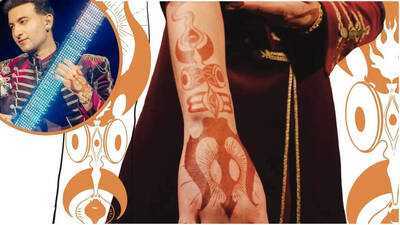
Santanu Hazarika x Rishab Rikhiram Sharma: Multidisciplinary visual artist explains 'Trident' design on sitarist's hand
What happens when music and art meet? Something extraordinary is expected to culminate, right? That is exactly what happened as renowned multidisciplinary visual artist Santanu Hazarika joined hands with celebrated sitarist Rishab Rikhiram Sharma . Santanu gave a unique artistic touch to the creative ‘ Sitar for Mental Health India Tour ,’ by Rishab. Rooted in mutual respect and a shared passion for their crafts, the mehendi design thus created marks the celebration of the confluence of visual and musical expression. To get more insights on the collaboration , we had an exclusive conversation with Santanu Hazarika, and here are the excerpts.
Santanu Hazarika on collaborating with Rishab Rikhiram Sharma“This collaboration happened because Rishab and I have been good acquaintances for quite some time. We share a mutual respect for each other’s art forms, have been following each other's work, and have met before to discuss working on a bunch of ideas. This was more like a short teaser, an experiment to see what we could create together. And honestly, it all came together pretty quickly,” he said.
“He just hit me up one day like, “Hey bro, would you like to do a mehendi design?” And I was like, yeah, why not? I mean, his hands are some of the most gifted in the entire industry, so it was an honor to do something like that. Especially turning it into a mehendi art form by Sona, it felt really epic. Because honestly, I never knew what it would end up looking like as mehendi,” continued the artist.
Santanu Hazarika explains the design and the creative process“The entire design was basically inspired by what Rishab had told me. He always incorporates a trident, or trishul, on his hand in some form of mehendi design before his shows. So the whole idea revolved around the iconography of Mahadev, or Shiva,” said Santanu before adding, “It also drew from elements of his visual language, along with mythological symbols that carry much deeper meaning. For example, we included the Naag, the Damru, the trident, and the third eye.”
“We also added the three horizontal stripes, which represent the Tripurantak form. And yeah, all of these elements were brought together to create a design that flowed beautifully with what he plays and how he likes to wear it on his body, as a statement and as an art form,” he concluded.
Santanu Hazarika on collaborating with Rishab Rikhiram Sharma“This collaboration happened because Rishab and I have been good acquaintances for quite some time. We share a mutual respect for each other’s art forms, have been following each other's work, and have met before to discuss working on a bunch of ideas. This was more like a short teaser, an experiment to see what we could create together. And honestly, it all came together pretty quickly,” he said.
“He just hit me up one day like, “Hey bro, would you like to do a mehendi design?” And I was like, yeah, why not? I mean, his hands are some of the most gifted in the entire industry, so it was an honor to do something like that. Especially turning it into a mehendi art form by Sona, it felt really epic. Because honestly, I never knew what it would end up looking like as mehendi,” continued the artist.
Santanu Hazarika explains the design and the creative process“The entire design was basically inspired by what Rishab had told me. He always incorporates a trident, or trishul, on his hand in some form of mehendi design before his shows. So the whole idea revolved around the iconography of Mahadev, or Shiva,” said Santanu before adding, “It also drew from elements of his visual language, along with mythological symbols that carry much deeper meaning. For example, we included the Naag, the Damru, the trident, and the third eye.”
“We also added the three horizontal stripes, which represent the Tripurantak form. And yeah, all of these elements were brought together to create a design that flowed beautifully with what he plays and how he likes to wear it on his body, as a statement and as an art form,” he concluded.
Contact to : xlf550402@gmail.com
Copyright © boyuanhulian 2020 - 2023. All Right Reserved.