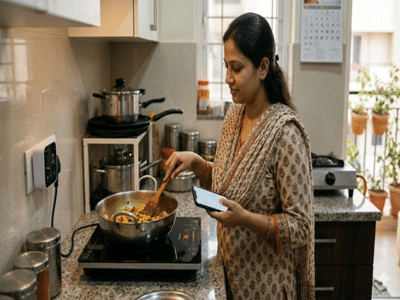
Amidst the shortage of cooking gas, induction cooktops have emerged as a convenient alternative in most households. However, this shift has also brought with it concerns regarding rising electricity bills. In this context, if an induction cooktop is used smartly, it not only simplifies cooking but also makes energy conservation possible—here is what the experts have to say...

Cooking on an induction cooktop is undoubtedly convenient, but it requires a proper understanding of its features and the correct techniques. By adopting the right methods, you can prepare delicious meals in less time while simultaneously reducing electricity consumption.
**Prepare for Cooking in Advance**
The easiest way to save energy on an induction cooktop is to prepare your ingredients before you start cooking. Cut vegetables into smaller pieces so that they cook faster. Always cook with the vessel covered; this traps the heat inside, thereby reducing the cooking time. If possible, boil water in advance, as this aids significantly in steam cooking.
**Soaking Lentils and Rice is Beneficial**
According to Ayurveda, soaking lentils (dal) and rice for a few hours before cooking is not only beneficial for your health but also helps in saving energy. Soaked grains cook faster, resulting in savings of both time and electricity.
**Use Induction-Friendly Cookware**
Always use cookware with a flat and thick base on an induction cooktop. Steel or induction-friendly non-stick vessels are the best choices. Thin-walled or non-magnetic vessels take longer to heat up, which leads to increased electricity consumption. If you cook items like rice or soup using the appliance's preset modes, the temperature will remain optimally regulated.
**Avoid These Mistakes**
Do not switch on the induction cooktop with wet hands, and avoid placing wet vessels on it.
Never turn on the induction cooktop with an empty vessel placed on it.
Refrain from using non-magnetic cookware.
Avoid cooking continuously at very high temperatures.
Avoid frequently switching the appliance on and off.
Use a cotton cloth or a microfiber cloth for cleaning purposes.
**Make Proper Use of Power Settings**
Lavanya Pandey, who has been cooking on an induction cooktop for a long time, shares her experience, noting that cooking at lower temperatures consumes less electricity. Induction cooktops feature distinct modes tailored to various dishes. Utilize the specific, pre-set modes for items such as milk, idlis, or for pressure cooking. The habit of cooking everything using a single, uniform mode leads to a wasteful expenditure of both time and electricity.
**Significant Savings in the Kitchen**
A key advantage of induction cooktops is that—even after the unit has been switched on—no energy is consumed unless a cooking vessel is placed upon it. In contrast, when it comes to gas stoves, fuel is consumed continuously, even when cooking over a low flame. Furthermore, cooking with the "Power Saving Mode" enabled presents another excellent option for maximizing efficiency.
PC Social Media
Contact to : xlf550402@gmail.com
Copyright © boyuanhulian 2020 - 2023. All Right Reserved.