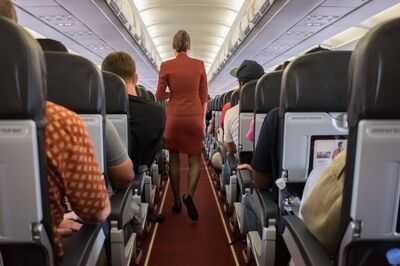
A flight attendant has lifted the lid on a trade secret about the moment passengers board a plane. The little known fact explains why passengers are welcomed at the aircraft doors during boarding.
Most air travellers are well acquainted with the customary warm reception at the plane doors, which typically involves broad smiles and even some direction on locating their allocated seat. The most widespread assumption is that this is simply a display of good customer service, with the flight attendants, the public face of any airline, setting the tone with courtesy and decency.
Another presumption is that the welcome is intended to set passengers up for an enjoyable flight experience, or perhaps verify boarding passes one last time. However, one serving flight attendant claims that hospitality is not the primary driving force behind the warm greeting. The genuine reason for the friendly reception is to carry out a visual assessment of passengers from head to toe before take-off.
• UK passport fees to rise in April 2026 with new rule change
• Ryanair, TUI and easyJet ban everyday item from luggage with new rules
In a now- viral TikTok clip, MrsMiva - who claims to work for TUI out of Stuttgart airport - has revealed that flight attendants use the boarding process to assess whether passengers are fit to fly. According to the content creator, flight attendants are checking to establish whether passengers may be "too drunk or sick to fly".
In the caption accompanying the video, MrsMiva also clarifies that the greeting enables attendants to identify who could potentially assist in the event of an emergency. The video has been watched over 18 million times and sparked a flurry of discussion in the comments.
Numerous users confirmed they've definitely experienced the cabin crew greeting and that the reasoning behind it makes perfect sense. One commenter who purported to be a long-serving attendant verified the policy as well, writing: "FA (flight attendant) of eight years - or to check if they could be an ABA (able-bodied assistant)."
The comments also started to diverge into the various types of cabin crew passengers had come across. Some remarked they had "really chill" attendants, while others noted theirs were supportive when they were in poor health to travel.
Being able-bodied and physically capable is essential for passengers seated adjacent to emergency exit doors, which is potentially why attendants verify this at the entrance. Emergency exit seats are highly sought-after given that they provide additional legroom and have no row ahead of them.
That being said, occupying these seats means that a passenger must be willing and capable of helping cabin crew in the improbable event of an emergency. For this reason, Ryanair's terms and conditions stipulate that it "can change your allocated seats at any time, even if you had reserved it, if we need to do this for operational, safety or security reasons."
According to the airline's regulations, passengers wishing to occupy rows 1, 16, or 17, where emergency exits are situated, must fulfil specific requirements. These include being aged over 16, being physically capable of assisting during an emergency, travelling without an infant, not requiring any special assistance at the airport, not needing a seat belt extender, and not having an extra comfort seat reserved.
Should the added responsibility of emergency exit seats not appeal to you, there are alternative methods to guarantee extra legroom while on board.
Do you have a story to tell? Email: emma.mackenzie@reachplc.com
Contact to : xlf550402@gmail.com
Copyright © boyuanhulian 2020 - 2023. All Right Reserved.