NASA's Artemis II toilet costs $23M
05 Apr 2026
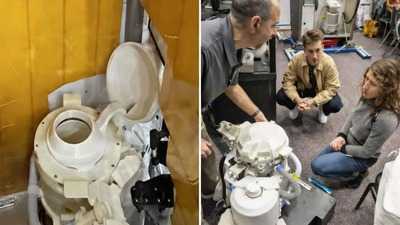
NASA's Artemis II mission has made history by becoming the first to send the first-ever sophisticated, functioning toilet around the Moon.
The Universal Waste Management System (UWMS) is a key part of this mission, which will help gather important data for future lunar expeditions.
However, the state-of-the-art lavatory comes with a hefty price tag of $23 million.
Initial pump issue resolved by mission specialist Christina Koch
Technical glitch
Designed for improved hygiene, the UWMS encountered a pump issue due to insufficient water, shortly after launch.
However, the problem was resolved in no time by mission specialist Christina Koch.
The toilet works by sucking away waste instead of relying on gravity like Earth toilets. It has two systems: one for urine collection via a hose and another for solids via a bucket-size cylinder.
How is the UWMS different from previous space toilets?
Technological advancement
The UWMS is a major improvement over earlier space toilets. It replaces plastic bags with a suction system, ensuring waste is stored safely and hygienically.
Each astronaut has their own custom collection funnel for urine while solids are kept in a bucket-size cylinder until they return home.
This design not only improves hygiene but also makes the process more private for astronauts during missions.
Most expensive toilet after Space Shuttle Endeavour's waste collection system
Lavatory legacy
The UWMS is the second most expensive toilet system ever made, costing American taxpayers $23 million.
The first model, which cost $11.5 million, was installed on the International Space Station (ISS) in 2020.
However, it falls short of the record set by Space Shuttle Endeavour's Waste Collection System that cost around $30 million to create and install in 1992 (inflation-adjusted cost: nearly $70 million today).
Contact to : xlf550402@gmail.com
Copyright © boyuanhulian 2020 - 2023. All Right Reserved.