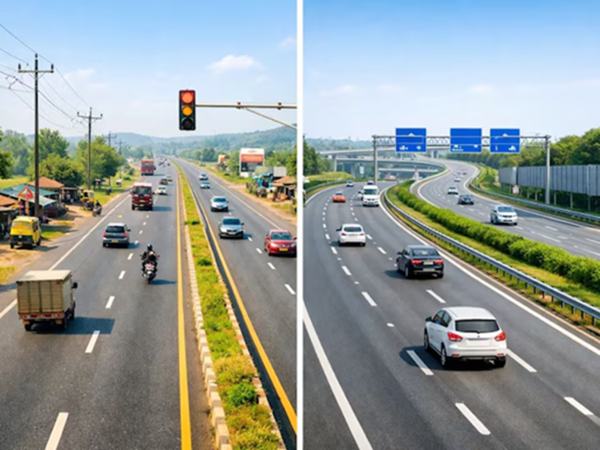
India's road network is one of the largest in the world, with millions of people traveling on it every day. However, people often mistake 'highways' and 'expressways' for the same thing, despite there being significant differences between the two. A lack of accurate information often leads people to violate traffic rules, thereby increasing the risk of accidents. Consequently, understanding the distinction between these two types of roads is crucial.
**What is a National Highway?**
National Highways are roads that connect the country's major cities, state capitals, and other important locations. They are developed and managed by the National Highways Authority of India (NHAI). These roads can consist of 2 lanes, 4 lanes, or more, and feature numerous intersections and connecting feeder roads along their length. Typically, the speed limit on these roads is 100 km/h for cars and 80 km/h for two-wheelers.
**What is an Expressway?**
An expressway is a more modern and high-speed type of road compared to a standard highway. It features 6 to 8 lanes and operates on a fully controlled-access system. This means that vehicles can only enter and exit the road through designated entry and exit points. There are no intermediate intersections or connecting roads, which significantly reduces the likelihood of accidents. The Agra-Lucknow Expressway serves as a prime example of such a road.
**The Biggest Difference Between Highways and Expressways**
The most significant difference between the two lies in their entry and exit points. Highways have numerous points where other roads merge or connect, whereas expressways have a limited number of designated entry and exit points. Expressways are generally wider and safer, having been specifically designed to facilitate high-speed travel. Consequently, the speed limit for cars on expressways can be as high as 120 km/h, whereas it is lower on standard highways.
**Driving Rules and Precautions**
On many expressways, the operation of bikes and scooters is strictly prohibited. Violators of this rule may face heavy fines. Conversely, two-wheelers are permitted on highways; however, riders are required to strictly adhere to the prescribed speed limits. In both settings, it is essential to wear seat belts and helmets and to adhere to traffic regulations in order to ensure a safe journey.
**Safe Travel Through Proper Knowledge**
By understanding the distinctions between highways and expressways, you can not only comply with the rules but also make your journey both safe and comfortable. In today's times, safety is just as crucial as speed. Therefore, it is the responsibility of every traveler to understand and adopt these rules before setting out on the road.
Disclaimer: This content has been sourced and edited from News18 Hindi. While we have made modifications for clarity and presentation, the original content belongs to its respective authors and website. We do not claim ownership of the content.
Contact to : xlf550402@gmail.com
Copyright © boyuanhulian 2020 - 2023. All Right Reserved.