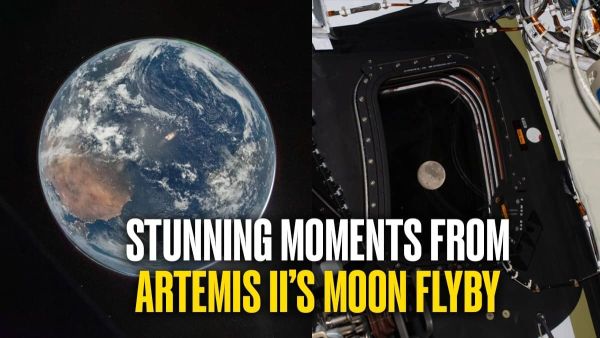
NASA’s Artemis II mission didn’t just revisit the Moon, it redefined how we experience space travel, with live updates, emotional crew messages and moments that felt straight out of a movie.
Here’s how the entire lunar flyby unfolded.
The Moment It Began: Entering The Moon’s Realm
As the Orion spacecraft approached the Moon, the crew entered what NASA calls the lunar observation window, a crucial stretch lasting nearly seven hours. During this time, Orion was perfectly aligned, its windows facing the Moon, allowing astronauts to study the surface in unprecedented detail.
Floating just over 4,000 miles above the lunar surface, the crew observed iconic features like the mysterious Reiner Gamma swirl and massive impact craters stretching hundreds of miles.
Back on Earth, scientists listened intently. Every observation, even subtle colour differences, mattered. Shades of brown and blue spotted by the human eye could reveal the Moon’s mineral composition and age.
One last look at Earth before we reach the Moon.
— NASA (@NASA) April 5, 2026
This view of the Earth was captured on April 5, the fourth day of the Artemis II mission, from inside the Orion spacecraft. The four astronauts will reach their closest approach of the Moon tomorrow, April 6. pic.twitter.com/z2NJUGWkKc
Breaking Records: Farther Than Any Human Has Gone
Then came a historic milestone.
At 252,756 miles from Earth, the Artemis II crew travelled farther than any human in history, surpassing the record set during Apollo 13.
It was a quiet but powerful moment. The crew paused to reflect not just on how far they had come, but on how much further humanity could go.
In a deeply personal touch, they even proposed names for previously unnamed lunar craters, one called “Integrity” for the mission, and another “Carroll” in memory of astronaut Reid Wiseman’s late wife.
Closest Approach: Skimming The Moon
Around 7 pm (ET), Orion made its closest pass, just 4,067 miles above the Moon.
The spacecraft was hurtling through space at over 60,000 miles per hour relative to Earth, yet moving much slower relative to the Moon — a delicate dance of gravity and motion.
This was the heart of the flyby — the moment when science, speed, and precision aligned perfectly.
LIVE: Watch with us as the Artemis II astronauts make their closest approach to the Moon, traveling farther from Earth than ever before. https://t.co/Zpy7GdTqA8
— NASA (@NASA) April 6, 2026
‘We Love You From the Moon’ & Then Silence
Soon after, something dramatic happened.
As Orion slipped behind the Moon, communications with Earth went dark.
For about 40 minutes, the crew was completely cut off, a planned blackout caused by the Moon blocking radio signals.
Just before the silence, astronaut Victor Glover sent a message that captured the emotion of the mission:
“To all of you down there on Earth… we love you, from the Moon. We’ll see you on the other side.”
During this blackout, the crew witnessed a rare sight — “Earthset”, as our planet disappeared behind the Moon’s horizon.
Earthrise & A Signal Reborn
Then, just as suddenly, Earth returned.
As Orion emerged from behind the Moon, the crew witnessed a stunning Earthrise, our blue planet glowing against the darkness of space.
Moments later, communication was restored. The Deep Space Network locked back onto the spacecraft, and voices from Earth filled the cabin once again.
"We will always choose each other."
— NASA Artemis (@NASAArtemis) April 6, 2026
Mission control has reacquired signal with the Artemis II crew after the mission’s planned loss of signal. Our astronauts are once again using the Deep Space Network to keep conversation and science data flowing between space and Earth. pic.twitter.com/aagRApba1z
A Solar Eclipse, From Space
The spectacle wasn’t over.
As Orion, the Moon, and the Sun aligned, the crew entered a solar eclipse lasting nearly an hour.
From their vantage point, the astronauts saw the Sun disappear behind the Moon, revealing its glowing outer atmosphere, the corona.
They also watched for tiny flashes on the lunar surface, meteoroids striking the Moon, offering clues about potential dangers for future missions.
Artemis II is now entering a solar eclipse that will last for about an hour as Orion, the Moon and the Sun align. During this phase, the crew will see the Sun disappear behind a mostly darkened Moon. pic.twitter.com/VHdY5oa7aE
— NASA Artemis (@NASAArtemis) April 7, 2026
Science In Real Time
Throughout the flyby, this wasn’t just a visual journey, it was a live scientific mission.
Teams on Earth continuously updated the astronauts with new instructions based on what they were seeing. It was a dynamic back-and-forth, a real-time collaboration across nearly a quarter-million miles.
From massive basins like Orientale to ancient impact scars on the far side, every observation added a new piece to the puzzle of the Moon’s history.
Coming up next, our @NASAArtemis astronauts and @NASAAdmin answer questions from social media. Stay tuned: https://t.co/do2p0Gvxdu
— NASA (@NASA) April 7, 2026
WATCH IN FULL ?? https://t.co/NBEzoT1uwR pic.twitter.com/V2e1pY4wlv
— The White House (@WhiteHouse) April 7, 2026
The Journey Home Begins
By 9:35 p.m. (ET), the lunar observation phase came to an end.
The Artemis II crew had completed their flyby, a full seven hours of science, exploration, and history-making.
Now, Orion has begun its journey back to Earth, set to exit the Moon’s gravitational influence soon, carrying with it data, images and a renewed sense of possibility.
Why This Mission Matters
Artemis II is more than just a flyby. It’s a statement.
More than five decades after humans last ventured to the Moon, this mission proves we’re not just returning, we’re preparing to go further.
The Moon is no longer the final destination. It’s the beginning of the next chapter.
Contact to : xlf550402@gmail.com
Copyright © boyuanhulian 2020 - 2023. All Right Reserved.