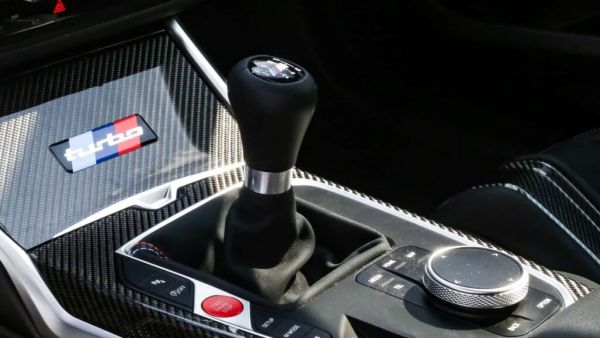
The manual gearbox isn’t dead at BMW just yet. But it’s definitely fighting for survival.
Earlier this year, BMW M boss Frank van Meel stirred debate when he said manual transmissions “don’t really make sense from an engineering standpoint.” His reasoning was straightforward. Modern performance engines produce more torque than traditional manual gearboxes can reliably handle. Automatic transmissions, on the other hand, can manage higher power outputs with greater efficiency.
Still, BMW isn’t ready to pull the plug completely.
According to Sylvia Neubauer, Vice President of Customer, Brand, and Sales at BMW M, engineers are actively working on a solution to keep the clutch pedal alive. While she didn’t reveal specifics, her message was clear. BMW knows enthusiasts still want manuals, and the company is trying to find a way to deliver.
Engineering vs Emotion
The challenge is simple but difficult to solve. BMW’s signature 3.0-liter inline-six continues to gain power. As performance climbs, traditional manual gearboxes struggle to keep up.
One potential workaround is already in use. BMW could limit engine torque in manual versions to preserve durability. This isn’t theoretical. The current BMW M2 already does this. The automatic version produces 50 Nm more torque than the manual variant.
It’s a compromise. Drivers still get three pedals, but not the engine’s full potential.
From a purist perspective, that’s still better than losing manuals entirely.
Declining Demand Complicates Matters
The bigger issue is demand. Manual take rates have dropped sharply across the industry. That makes it difficult for manufacturers to justify investing millions in developing new manual gearboxes.
Even suppliers are hesitant. Producing low-volume transmissions doesn’t make financial sense. Without economies of scale, costs rise quickly.
There’s also the reality of modern technology. Advanced driver-assistance systems are easier to integrate with automatic transmissions. As vehicles become more complex, manuals naturally become harder to support.
Emissions Regulations Accelerate the Shift
Stricter emissions rules are another major factor. Automatic transmissions often deliver better fuel efficiency and lower CO₂ emissions. For automakers facing tough regulatory targets, that difference matters.
If automatics help reduce fleet emissions, manuals become harder to justify.
This is especially true in Europe, where manufacturers face heavy fines for exceeding emissions limits. Every gram of CO₂ counts.
What’s Next for BMW Manuals?
Despite the challenges, BMW’s combustion-engine performance cars aren’t going anywhere just yet. The company has already confirmed a next-generation M3 with a six-cylinder engine, expected around 2028. That suggests internal combustion M cars will continue into the 2030s.
But manual availability remains uncertain.
The Z4 M40i manual is already being phased out. That leaves just the M2, M3, and M4 as BMW’s remaining manual offerings. These models are expected to stay in production for a few more years, giving enthusiasts a limited window.
A Last Chance for Enthusiasts
The reality is clear. Manuals are becoming niche products in an industry moving toward electrification, automation, and efficiency.
BMW isn’t giving up yet, but the clock is ticking.
For enthusiasts who still believe driving should involve three pedals and full engagement, the message is simple. If you want a manual BMW, now might be the time.
Contact to : xlf550402@gmail.com
Copyright © boyuanhulian 2020 - 2023. All Right Reserved.