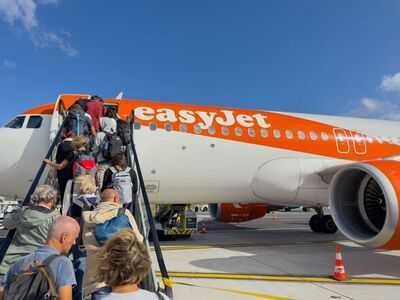
EasyJet has issued a fresh warning to passengers online, stating: "You will not be able to board and will miss your flight". The carrier clarified everything in a recent social media post responding to a traveller who sought advice about their forthcoming journey.
This follows EasyJet sharing an "important update" on its website last week, notifying passengers that lengthy queues are anticipated due to new border controls. It stated: "Airports across Europe may experience longer queues at passport control whilst the new European Entry/Exit System (EES) border checks are being completed."
It continued: "This will mean you may need to have your biometrics taken, including your face and fingerprints scanned." From spring 2026, visitors from beyond the EU, including British travellers, will be required to register their fingerprints and have photographs taken.
The new regulation could lead to extended waiting periods, potentially reaching two to three hours at principal airports. One traveller contacted EasyJet after spending an hour in a passport control queue, risking missing their boarding gate, reports the Mirror.
On X, a user called KezOsman wrote: "EasyJet, we have 20 mins left until our flight from Palermo to London takes off, been in finger print queue for an hour now and moved three steps. They let LOADS of BA people through before us who are leaving 10 mins before our flight, and now we're even more delayed. What will happen?"
In response, a customer service team member named Thando wrote on April 8: "Hi Kez, thank you for reaching out. Please note that the boarding gate closes a minute before departure. After it closes, you will not be able to board and will miss your flight."
The moment travellers realise they are at risk of missing their boarding gate, they should notify their airline immediately via the app, email, or telephone. Passengers can also seek assistance from airport staff, as certain airports provide electric buggies or allow those with tight connections or imminent departures to jump to the front of the queue.
Travellers are strongly encouraged to arrive at the airport with plenty of time to spare to account for any unforeseen hold-ups at security or passport control. A spokesperson for ABTA, the association of travel agents and tour operators, says: "We're advising passengers to go straight to passport control as soon as you have gone through check-in and security; that way you get the EES checks out of the way as early as possible.
"We're also advising passengers to follow their transport provider's advice on when to arrive at airports/ports etc. If flying, the usual rule is to arrive at the airport for a flight from Europe at least two hours before, so we'd encourage people to apply that as a minimum, but to also check with their airline and airport."
Passengers are urged to remain patient as the new system is introduced. EasyJet suggests:
- Plan your travel to and through the airport, as you may experience longer queues.
- If you need to go to Bag Drop, go there as soon as it opens.
- Make your way through security as early as possible.
- There may be additional checks at passport control before your gate.
- Head to the gate or boarding area as soon as it's announced.
- Make sure you have the correct documents to travel.
- You may experience longer queues in your arrival airport.
The European Union's new EES launched on 12 October 2025. It is a groundbreaking digital border system that has transformed requirements for British citizens travelling to the Schengen area. EES checks are being rolled out in a phased manner for non-EU and UK travellers, with full operation anticipated from April 2026.
If you are travelling to a Schengen country for a short stay using a UK passport, you will be required to register your biometric data, including fingerprints and a photograph, upon arrival. No action is needed prior to reaching the border, and EES registration is completely free of charge.
A statement on Gov.uk reads: "After it is fully implemented, EES registration will replace the current system of manually stamping passports when visitors arrive in the EU, but during the phased implementation, border points will also stamp passports. EES may take each passenger a few extra minutes to complete so be prepared to wait longer than usual at the border once the system starts."
The countries within the Schengen area include: Austria, Belgium, Bulgaria, Croatia, Czechia, Denmark, Estonia, Finland, France, Germany, Greece, Hungary, Iceland, Italy, Latvia, Liechtenstein, Lithuania, Luxembourg, Malta, Netherlands, Norway, Poland, Portugal, Romania, Slovakia, Slovenia, Spain, Sweden, and Switzerland. The Republic of Ireland and Cyprus fall outside the Schengen area, meaning EES does not apply when visiting either destination.
Contact to : xlf550402@gmail.com
Copyright © boyuanhulian 2020 - 2023. All Right Reserved.