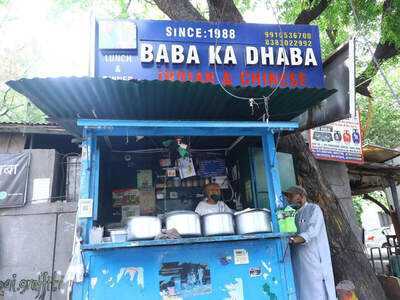
At first, it looked like one of those fleeting internet moments that usually burns bright for a day and then disappears. But the clip showing an elderly man in tears at a tiny roadside eatery in Delhi did something rare: it made millions look twice. Within hours, “Baba Ka Dhaba” in Malviya Nagar had gone from a local stall fighting for customers to a national symbol of compassion, survival and the strange power of social media to rewrite a life. Scroll down to know more.
The video that changed everythingThe man at the center of the story was Kanta Prasad , who ran the stall with his wife, Badami Devi. In the video shared by food creator Gaurav Wasan, Prasad spoke about how badly business had fallen during the lockdown and how little food he was able to sell each day. The clip spread quickly, and the next morning, customers began lining up outside the stall from early hours. By noon, the food was gone.
What made the moment so powerful was its simplicity. There was no polished campaign, no corporate rescue, no manufactured sentiment. Just an elderly couple, a few steel plates, and a public suddenly confronted with the reality that a small business can collapse not with a dramatic crash, but with silence, no customers, no earnings, no certainty about the next meal.
From struggle to sudden attention
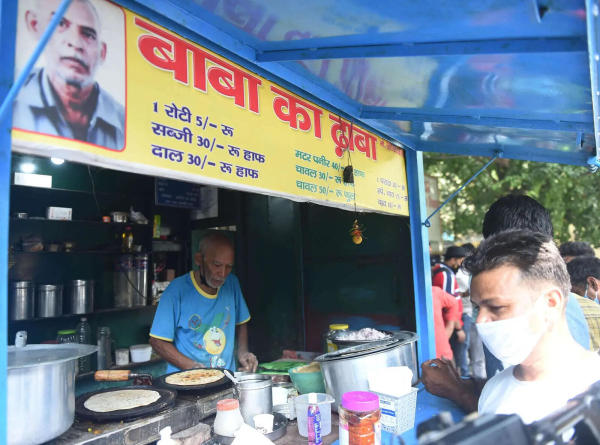
Before the viral wave, Baba Ka Dhaba had already been running for decades, serving low-cost home-style food in South Delhi. The BBC reported that Prasad and Devi opened the stall in 1990 and sold simple meals at prices that remained modest even as the pandemic hit hard. The video transformed that invisible struggle into something the country could not ignore. Donations came in, television crews arrived, and the couple suddenly found themselves at the center of an overwhelming public response.
The story also became a snapshot of pandemic India. Small vendors, street food sellers and informal workers were among the hardest hit when lockdowns emptied roads and offices. Baba Ka Dhaba became a shorthand for all those whose livelihoods depended on daily footfall and who had no safety net when the footfall vanished. That is why the reaction was so immediate: people saw more than a viral video, they saw a national wound.
Help came fast, but life did not become simple
The sudden attention brought money, food and visibility. According to BBC, the influx of support helped Prasad clear debts, repair his house and put food on the table for his family. He then used that momentum to open a new restaurant in December 2020 near the old stall. For a brief moment, it looked like the viral rescue had delivered a lasting turnaround. 
But the road after virality was not smooth. By early 2021, the restaurant had shut down, and Prasad returned to the roadside stall. Reports in June 2021 noted that life had, in many ways, come full circle: Prasad was back at the same eatery only months after attempting a bigger venture. The detail is telling. Internet fame can lift expectations overnight, but turning that sudden attention into a steady, sustainable livelihood is far harder.
The controversy that followed
The Baba Ka Dhaba story later entered a complicated phase when Prasad filed a police complaint alleging that funds collected in his name had not been handled properly. Several outlets reported the complaint in November 2020. In the months that followed, both sides indicated that the matter had eased, but the episode quietly underscored a larger reality: viral generosity can move quickly, and managing sudden public attention often brings its own unexpected challenges.
That controversy never fully erased the original story. It simply complicated it. The couple had been helped, yes, but they were also thrust into a spotlight they had not asked for, with money, publicity and public opinion all arriving at once. For an elderly street-food seller, that is a lot to absorb in a single season.
What they are doing now
The latest available reporting in May 2025 suggests that Prasad had returned to his original dhaba after the restaurant venture closed, with the old stall once again becoming the centre of his daily work. The viral moment did bring significant support and briefly opened the door to a larger venture. In the end, however, it also led him back to the modest eatery where his story first captured the internet’s attention.
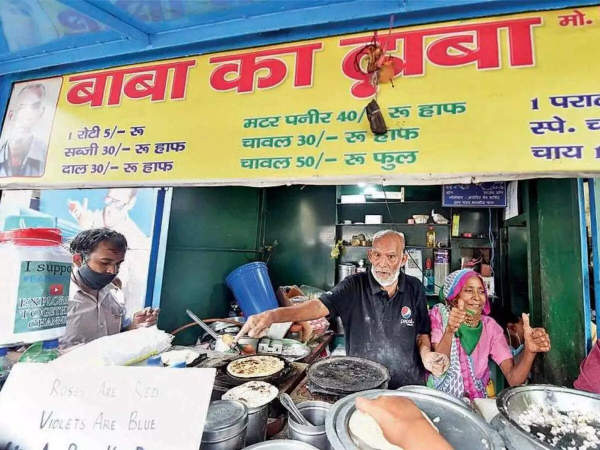
That may be the most honest ending of all. Baba Ka Dhaba was never just about a video that made people feel good for a day. It was about an elderly couple trying to stay afloat, a city that briefly noticed them, and a fragile kind of hope that arrived through a screen and then had to survive real life. The fact that Prasad returned to his old stall only makes the story more human, not less.
Why the story still lingers
Years later, Baba Ka Dhaba remains memorable because it captured something larger than a food stall. It showed how quickly people can rally around dignity when they are given a face to care about. It also showed how easily that care can fade once the feed moves on. The couple’s story is not a fairy tale. It is something tougher, stranger and more revealing: a portrait of survival in public.
The original video may have lasted a few minutes, but its aftermath stretched far longer. It fed a family, sparked a debate, brought a restaurant, triggered a controversy and finally returned an elderly man to the same roadside stall where the country first found him. That is why Baba Ka Dhaba still matters. It was never only a viral clip. It was a life exposed to the internet and changed by it.
Contact to : xlf550402@gmail.com
Copyright © boyuanhulian 2020 - 2023. All Right Reserved.