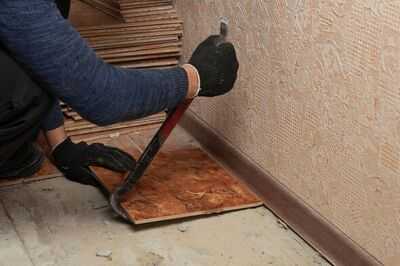
A woman who recently acquired her own property and promptly began renovation work has been left astonished after removing the floorboards.
Kim Ladd took to TikTok to showcase her unfortunate discovery after her hopes of unconvering stylish tiling work were quickly dashed. Nevertheless, what she actually revealed was something vastly different.
"Definitely going to keep it," Kim said in a video, before highlighting that it was actually "wet concrete". It prompted scores of TikTok users to offer guidance to prospective purchasers on how she should address the problem to prevent further harm to the foundations of her property.
"This is why homeowners need to be educated on quality of materials prior to purchasing a home," one person pointed out. "There's too many people doing DIY fixes that people think 'look nice' but are expensive to rehab and correct."
A second advised: "If you bought a newer build check if the neighbours had this issue! We had the same exact thing - LVP slapped onto concrete with no moisture barrier causing issues and it turns out everyone in the neighborhood was having the floors replaced by the builder. We got a settlement to replace the floors ourselves."
A third recalled: "Had this as well... not to this extent though. You got puddles man? You're going to need more than just an underlayment." While a fourth TikTok user pondered: "I'm genuinely afraid that's what is happening in my house. Ugh! Now I'm gonna have to pull up a piece and see what we find."
According to Bayland Flooring, one of the most significant disadvantages of laminate is its vulnerability to moisture. The company elaborates online: "Unlike hardwood that can be dried and refinished, laminate's layered composition makes it highly susceptible to warping and staining when wet.
"The longer the water sits, the more it can seep between the cracks, causing the boards to swell, buckle, and even grow mould."
The key is to act fast at the first sign of moisture. Some warning signs that your laminate is taking on water include:
- Cupping or crowning planks
- Bulging seams
- Discolored or spongy-feeling spots
- A musty, damp odour
However, DIY drying isn't always sufficient, as Bayland Flooring explained further: "In severe cases where the water has saturated the laminate for an extended period, a professional touch may be necessary.
!Laminate that has absorbed substantial moisture often needs to be removed to allow the subfloor to completely dry out. Attempting to dry soaked laminate in place can trap water and encourage mold and mildew growth."
Contact to : xlf550402@gmail.com
Copyright © boyuanhulian 2020 - 2023. All Right Reserved.