By Binod Prasad Adhikari
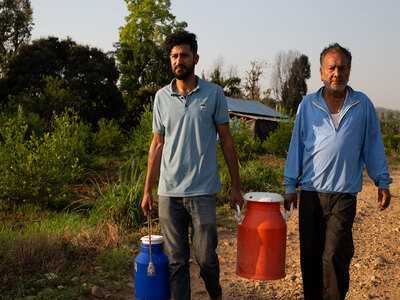
Makwanpur [Nepal], April 13 (ANI): Ram Mani Neupane's day starts from the cow shed and ends in the cow shed itself. On average, he spends 6 to 7 hours taking care of his four cows on a daily basis. He leaves no stone unturned to ensure care for his Holstein breed of cow, which has become his calling, for him to return to Nepal and start his own business.
Ram Mani spent seven years of his life as a migrant worker in middle-east nation working under harsh conditions, as labor riding on the high hopes of living a better life after earning enough money. Distancing from family and working in extreme weather conditions as migrant labour encouraged him to end the struggle there and return home.
"I worked as a migrant worker for about seven years abroad. Comparing the labour that I did there with that I am doing now, I am satisfied here. Though I used to earn over one hundred thousand per month in the Gulf, with four cows am saving fifty thousand a month, deducting all the expenses. I am more satisfied here because I am also getting a chance to be with my family," Ram Mani told ANI.
"I have four cows, which give 25 litres of milk in the morning and another 25 litres of milk in the evening, which means an average of 50 litres of milk in a day. The milk is taken to the milk collection centre, and I have been earning about NRs 100,000monthly on average. If I deduct the expenses on the cow fodder and other essentials, I have been spending about fifty per cent of it, and the remaining fifty is the gross profit, which means I can save at least fifty thousand rupees per month from the sales of milk," he added.
Ram Mani's flight of living a better life landed safely in the cow firm after rigorous efforts and failed experiments in other businesses. He had tried running a photo studio, a grocery shop, amongst others, but a regulatory change by his home local government attracted him to the cow farm business.
"I was in search of some business which would be more secure and give me stability; while filtering all the available options, I found my calling in a cow farm. The rural municipality, through its plans and policies, has ensured payment for the farmers, which enables the farmers to work on this field, which has convinced the farmers. Seeing this security from the governmental body, I also was intrigued and started this business," Ram Mani recalls.
Nepal relies heavily on agriculture, with about 1.7 million households engaged in cattle farming as per the 2021 National Agricultural Census conducted by the Central Statistics Office. The census also recorded a significant decrease in the number of farmers raising cows and bulls, which reveals that 17.8 lakh families are engaged in cattle farming, representing a notable reduction of 5,73,000 families compared to the previous census in 2011, when 22.81 lakh families were involved in cattle rearing. The data further highlights that an average Nepali family now owns about three cows and bulls.
The Central Statistics Office reports that the overall number of cows and bulls in Nepal has diminished by 18 lakhs 771,000. Presently, the total cattle population stands at 45.59 lakhs, a considerable decline from the 64.30 lakh recorded in June 2011.
But Ram Mani's Manahari Rural Municipality, ward number one, has a different approach, which has further encouraged the farmers to herd the cows. The local body, through its local municipal council, has passed a resolution ensuring monthly payment to the farmers for their milk, which is collected at a local collection centre. This has boosted the number of cow farmers in the locality.
"In my ward number one, there is a milk collection centre where we collect the milk produced. The collection centre and the rural municipality have an agreement that the local body will purchase our produce, and payment will be made to the collection centre, which is then channelised to the bank accounts of the farmers. This agreement has ensured the payment from the sale of the milk, which has further enhanced the trust of farmers; we are all happy as we have been receiving the payments on time," Ram Mani told ANI.
As per the records, a total of 270 farmers on a daily basis have been supplying milk to the collection centre. On a daily basis, the ward number one alone collects about 3,200 litres of milk. The milk centre, every month, pays out about Nepali rupees (NRs) 6.8 million to the farmers.
"On a daily basis 3200-liter milk is produced from this single ward but back in the time when the milk was directly sold to the milk development association and it was making the payment, the production used to stand at 1200-litre per day. But now the rural municipality headed by chair Ranjan Kalakheti is making the payments directly to the farmers on monthly basis after being extended from previously agreed fortnightly payment has spearheaded in cow farming," Shiva Prasad Khanal, Ward Chair of Manahari- 01 told ANI.
The monthly payment system introduced by the local body has encouraged more farmers to get into the business of cow firm and settle back home.
Surrounded by hills, the Manahari Rural Municipality has 12,724 households. The ward number one of this rural municipality has been dominantly engaged in the business of cow firm. Out of them, 818 households of ward number one of almost all the household has at least one member abroad especially in the middle-east nations in search of the employment opportunity.
The rising trend of flying abroad in search of better opportunities and education has been rising in the Himalayan Nation with population less than 30 million. Majority of those flying abroad are youths and earning age group queuing up at the airport ready to take off leaving the elderlies behind.
An estimated 1,500 Nepali youths has been departing from the Tribhuvan International Airport to work abroad in the middle-east nations as a waged labor in search of better life and opportunities.
Making an exception to it, Sagar Khanal returned back to Manahari ending his twelve years stay in gulf nations.
"I stayed abroad as migrant worker for about 12 years and returned back home with the determination that I won't go back for work and I will be celebrating my first anniversary in next two months," Sagar told ANI as he worked in his cow firm.
Upon returning back home he started his own cow firm with 1.7 million Nepali rupees as investment where he is herding 30 cows.
On average, he fetches 150 litres of milk to the collection centre, grossing over 3.5 Lakhs Nepali rupees on a monthly basis. Making all the required expenses for the two staff and the cows, Sagar claims to be saving NRs 150,000 a month.
"The earnings that I made while working as a migrant worker can be made here only. To all those who had been closely associated with me, I have been requesting them to stay back in Nepal and get engaged in businesses of their own; all the earnings made while staying abroad (Gulf) would sustain till the time we are there, it will turn into zero upon our return back home. I also have worked for twelve years and can relate to the experience that I have earned," Sagar told ANI.
Apart from herding the cows, the farmers in Makari have been adopting modern tools and techniques as well. Ensuring the comfort and cleanliness of the cows, farmers use cow mats, dust nets, fans, music, as well as grow grass that is a favourite of the cow to maintain the quality as well as quantity of the milk.
The local milk collection centre, through an automated system, keeps a record of the farmers after checking the quality of the milk they have brought. The payment by the end of the month again has been playing an important role for the farmers here, as those in the neighbouring district of Chitwan had to spill the milk on the road in protest of not getting payment on time.
"The best amongst all is that we are being paid for our produced milk on a monthly basis-we have been receiving it as if the salaries are credited into our account. It has made us more determined to do cow farming to sustain," Sagar Khanal told ANI.
With the cow firm emerging as the main business and more investment pouring in, the local government is also expediting its preparations. The rural municipality has been timely distributing medicines for the cows as well as sending veterinary officials for routine check-ups of the herds.
"As the number of farmers engaged in cow farming has increased, we have appointed staff who specialise in the field of agriculture and veterinary. The rural municipality has a staff equivalent to fifth-level gazette staff specialising in animals," Shiva Prasad Khanal, the ward chair of the Manahari-1, told ANI. (ANI)
Contact to : xlf550402@gmail.com
Copyright © boyuanhulian 2020 - 2023. All Right Reserved.