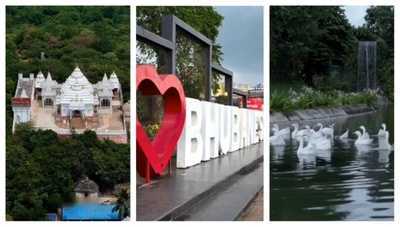
Bhubaneswar: Once hailed by Pandit Jawaharlal Nehru for its “undulating ground and cool breeze coming from the sea,” the temple city now battles scorching heat. On its 78th Capital Foundation Day, Bhubaneswar is pivoting to nature-based solutions (NbS) to reclaim that lost cool.
In a letter to then Odisha Chief Minister Dr Harekrushna Mahatab, Nehru wrote: “The past is represented by ancient temples, some of them famous for their architecture and artistry. The new town will be grouped in self-contained neighbourhood units, each comprising about 850 families. This will enable the town to grow without losing its community and neighbourly character. In each area residential houses will surround the schools and shopping centres and will be near to open fields and recreation grounds.”
That early vision of a balanced, green city now stands in sharp contrast to the heat and environmental stress Bhubaneswar experiences today.
Rising Heat and Liveability Challenges
Seventy-eight years on, the city is among the urban centres feeling the brunt of extreme heat. It recorded 44.2°C on March 31, 2021, and was reported as the hottest place in the world that day. In 2025, Bhubaneswar reportedly did not record a single day that met WHO air quality standards, underscoring the growing strain on its environment and liveability.
As summers arrive earlier and temperatures climb across Odisha’s towns and cities, including Bhubaneswar, the first response for many households with access to cooling has been to switch on air conditioners. That may offer immediate relief, but it is not a sustainable long-term answer on a warming planet.
Rising dependence on cooling adds pressure on electricity demand and, in turn, feeds emissions that deepen the climate problem.
Embracing Nature-Based Solutions
The city is, however, beginning to look at a different path through nature-based solutions.
“Today, we are celebrating the 78th Foundation Day of the capital of Bhubaneswar. On this occasion, we have decided on how to further develop Bhubaneswar as a green city and also create a safe environment for the students who are coming to the city to study,” Odisha Assembly Speaker Surama Padhy told the media.
While extending greeting to the city denizens, Bhubaneswar Mayor Sulochana Das stressed the need to make the state capital climate resilient and sustainable for all. “The temple city has become an education, sports and medical hub today. The city is progressing towards development. The city has climbed to rank 9 from rank 134 in the cleanliness index. We aim to take the city rank in the first three spots…,” she added.
Cooling the Urban Heat Island
The International Union for Conservation of Nature defines nature-based solutions as “actions to protect, sustainably manage, and restore natural or modified ecosystems, that address societal challenges effectively and adaptively, simultaneously providing human well being and biodiversity benefits.”
The logic is straight and simple. Like many cities, Bhubaneswar suffers from the urban heat island effect, where concrete and tarmac absorb the sun’s energy and release it slowly, keeping the city warmer well into the night.
Using its rivers, canals and natural streams more intelligently, the city can turn road verges and drainage channels into green corridors that soften the impact of heat and bring back some of the lost ecological balance.
On this 78th Foundation Day, Bhubaneswar has an opportunity to plant trees along major roads and neighbourhood streets, especially in areas that have the least green cover. Such an approach could help bring down temperatures by more than 2 degrees, while also making the city more comfortable for residents. Green corridors are one practical example of how urban planning can work with nature rather than against it, and monitoring their impact over time will be important to show the wider benefits.
…In Other Cities
The evidence for such measures is already well documented. Urban parks can reduce daytime temperatures by about 1 degree on average.
Milan, which faced power outages given the heavy air-conditioning demand during the scotching heat during summer, has announced a plan to plant three million trees by 2050 to cut heat island effects and improve air quality.
Green roofs, meanwhile, can reduce energy use by 10 to 15 per cent, and in cities such as Athens, they have been shown to reduce cooling loads in buildings by as much as 66 per cent.
A Path to Climate Resilience
For Bhubaneswar, nature-based solutions offer a way to adapt to climate change while also helping to mitigate it. As temperatures continue to rise, cities will have to rely on a mix of green infrastructure, better building design and passive cooling if they are serious about long-term resilience.
Cooling is no longer just a comfort issue; it is a public health priority, especially in urban centres like Bhubaneswar that are increasingly vulnerable to heat. Nature-based solutions alone will not solve the entire problem, but they can form a crucial part of the response.
To meaningfully cut emissions from the cooling sector, coordinated action will be needed from governments, businesses, civil society, and international organisations. The city once imagined as cool, green, and community-oriented may now need to rediscover that original vision to remain liveable in a hotter future.
Contact to : xlf550402@gmail.com
Copyright © boyuanhulian 2020 - 2023. All Right Reserved.