As media channels expand and content volumes rise, the way businesses evaluate advertising performance is also evolving. Speaking to ReadGuo Zhi Feng, chairman of Chicilon Media, said that the logic of assessing advertising effectiveness is being redefined. He noted that the key question is no longer how widely an advertisement is distributed, but whether it is actually seen under appropriate conditions.
Guo Zhi Feng said that in the past, brands often relied on metrics such as impressions, reach and click-through rates. When media resources were more limited, these indicators served as useful benchmarks.
Dual advertising screens installed in office lobby. Photo courtesy of Chicilon Media |
However, their ability to reflect actual effectiveness has diminished. The presence of an advertisement does not necessarily mean it is genuinely seen, and even when briefly viewed, it may not be retained.
“As the volume of information increases and user attention becomes more fragmented, many campaigns achieve wide distribution but fail to generate corresponding levels of awareness. Such a scenario requires a shift in how communication effectiveness is evaluated,” he said.
 |
Advertising screens installed an office lobby. Photo courtesy of Chicilon Media |
According to Chicilon Media, this raises a fundamental question: after deployment, is the advertisement effectively received by the audience? This reflects a broader shift in evaluation methods.
Rather than focusing solely on delivery, businesses are placing greater emphasis on whether advertisements are seen under suitable conditions. Measurement is also moving beyond surface-level indicators toward understanding how audiences perceive and process content.
From this perspective, advertising effectiveness is increasingly viewed as a process rather than a single outcome. Messages typically require repeated exposure to build recall before influencing consumer decisions.
This shift is also influencing media channel selection. According to Guo Zhi Feng, effective channels tend to share several characteristics: frequent audience exposure, sufficient dwell time, minimal distractions and clear content visibility, allowing repeated engagement by the same audience group.
When these conditions are met, advertising can maintain a consistent presence. Audiences absorb information gradually through repeated exposure, rather than relying on a single interaction.
Consistently visible and memorable brand helps to create effective advertising. Photo courtesy of Chicilon |
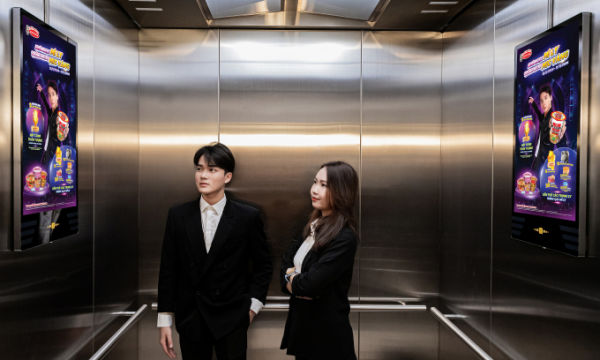
Guo Zhi Feng cited urban media environments as an example, particularly advertising in building elevator spaces, which meet many of these criteria. Elevators are part of daily routines and provide repeated, relatively stable exposure.
Their enclosed setting, fixed waiting time and limited distractions allow advertising content to be displayed clearly. Viewers can absorb information over a sufficient period, with repeated exposure contributing to memory formation.
He added that advertising effectiveness is not determined solely by the number of impressions, but by how content is delivered in the right environment and reinforced over time. Initial exposure may create basic awareness, while subsequent exposures strengthen the message. With sufficient frequency, the information is more likely to be retained and influence decision-making.
This approach helps businesses better understand the relationship between media environment, exposure frequency and communication effectiveness, supporting more efficient resource allocation aligned with long-term objectives.
Contact to : xlf550402@gmail.com
Copyright © boyuanhulian 2020 - 2023. All Right Reserved.