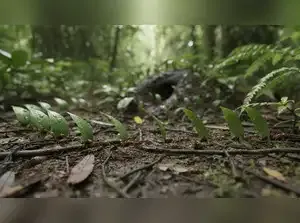
A trail of leaf-cutter ants marches along the ground, each transporting leaf fragments much larger than themselves. The leaves are not consumed directly. Rather, they are taken below ground to specially maintained chambers where another process occurs. Within the nest, fungi are cultivated that provide nourishment for the ants.
Although this activity was originally suggested by Thomas Belt in the 19th century, it was not until the practice was observed firsthand that scientists were able to confirm the cultivation of these fungi by the ants. As noted in Nature and PLOS Biology, rather than mere resource gathering, these ants maintain an active agricultural system that permits the growth of their fungal crops.
This system is based on mutual dependence
The symbiotic relationship between ants and fungi is extremely specific. While fungi get access to the plant material they need from ants and receive proper conditions for growth, ants receive nutrients that cannot be obtained through plant leaves. In particular, studies found in ScienceDirect and Nature Index point to the ability of ants to control fungi in their farms using plant material and suitable conditions for fungi growth.
However, this symbiotic relationship goes beyond only two organisms. As reported in Nature Communications, ants can carry specific bacteria, known as Pseudonocardia, that secrete anti-microbial compounds to ensure proper crop growth without diseases. Thus, this symbiosis is three-dimensional, and ants, fungi, and bacteria operate as a unit in an ecosystem.
How do we expand the definition of agriculture?
Fungus farming has been around for many years; however, modern scientific studies have shown that certain types of ants have transcended fungus farming to embrace other organisms. In particular, research in Current Opinion in Insect Science has described how ants of the Philidris nagasau species farm by nurturing plant growth in their natural habitats.
This action blurs the line between human activities and insect behaviors because it shows that there is room for farming to develop in different directions. Other scientific papers published in Scientific Reports and PLOS ONE have found that ants farm using specific microbiomes that are different among different colonies of ants. Such a discovery illustrates the complex nature of ant farming practices in that the ants can create stable farming systems in fungal gardens.
Although this activity was originally suggested by Thomas Belt in the 19th century, it was not until the practice was observed firsthand that scientists were able to confirm the cultivation of these fungi by the ants. As noted in Nature and PLOS Biology, rather than mere resource gathering, these ants maintain an active agricultural system that permits the growth of their fungal crops.
This system is based on mutual dependence
The symbiotic relationship between ants and fungi is extremely specific. While fungi get access to the plant material they need from ants and receive proper conditions for growth, ants receive nutrients that cannot be obtained through plant leaves. In particular, studies found in ScienceDirect and Nature Index point to the ability of ants to control fungi in their farms using plant material and suitable conditions for fungi growth.
However, this symbiotic relationship goes beyond only two organisms. As reported in Nature Communications, ants can carry specific bacteria, known as Pseudonocardia, that secrete anti-microbial compounds to ensure proper crop growth without diseases. Thus, this symbiosis is three-dimensional, and ants, fungi, and bacteria operate as a unit in an ecosystem.
How do we expand the definition of agriculture?
Fungus farming has been around for many years; however, modern scientific studies have shown that certain types of ants have transcended fungus farming to embrace other organisms. In particular, research in Current Opinion in Insect Science has described how ants of the Philidris nagasau species farm by nurturing plant growth in their natural habitats.
This action blurs the line between human activities and insect behaviors because it shows that there is room for farming to develop in different directions. Other scientific papers published in Scientific Reports and PLOS ONE have found that ants farm using specific microbiomes that are different among different colonies of ants. Such a discovery illustrates the complex nature of ant farming practices in that the ants can create stable farming systems in fungal gardens.