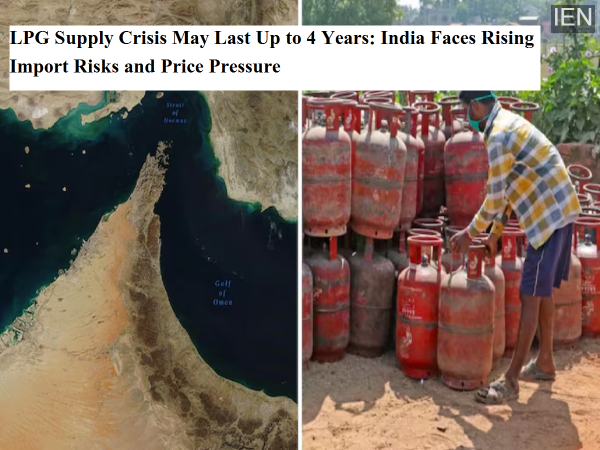
India could be staring at a prolonged energy challenge, as disruptions in the global LPG (Liquefied Petroleum Gas) supply chain may take up to four years to fully normalize. A senior government official has warned that the damage caused by recent geopolitical tensions is still not fully understood, making recovery timelines uncertain.
The ongoing supply shock is raising concerns over rising prices, import dependency, and the long-term stability of LPG availability for households and businesses.
Supply Disruptions May Take Years to Fix
According to a senior official, restoring LPG supply chains to normal levels could take 3 to 4 years, and possibly even longer. The uncertainty stems from the lack of clarity on whether production disruptions are temporary or permanent.
Some critical supply sources have reportedly been completely shut down, but it remains unclear whether this is due to halted production or structural damage to energy infrastructure.
Heavy Dependence on West Asia
India relies heavily on West Asian countries for its LPG needs. Nations like United Arab Emirates, Qatar, Saudi Arabia, Kuwait, Bahrain, and Oman together account for nearly 92% of India’s LPG imports, valued at around $6 billion in FY25.
Among these, the UAE contributes about 41%, while Qatar accounts for roughly 22% of total supply.
However, geopolitical tensions—especially disruptions in the Strait of Hormuz—have severely impacted supply routes, forcing India to rethink its sourcing strategy.
Import Dependency Remains High
India imports nearly 60% of its LPG consumption, and before the crisis, about 90% of these imports passed through the Strait of Hormuz.
Recent data shows that Gulf imports have dropped significantly, with their share falling to around 55% by late March. This indicates both supply disruptions and efforts to diversify sourcing.
Despite exploring alternative routes and suppliers, experts estimate that supply could still remain affected by 40–50%, suggesting that the crisis is far from over.
Limited Storage Adds to Risk
India’s LPG demand stands at approximately 33 million tonnes annually, but storage capacity is limited to just 15 days of consumption.
This low buffer makes the system highly vulnerable to even short-term disruptions. Any delay in supply can quickly translate into shortages and price spikes.
Prices Already on the Rise
The impact of supply disruptions is already visible in domestic prices:
- Domestic 14.2 kg LPG cylinder prices have increased by around ₹60 since mid-March
- Commercial LPG cylinders have become costlier by up to ₹115
In addition to supply issues, rising shipping and insurance costs are also pushing prices higher.
Government Exploring Emergency Measures
To manage the situation, the government is considering strategies similar to those used during the COVID-19 period.
These include:
- Diversifying import sources
- Changing shipping routes
- Increasing domestic LPG production
- Managing demand to avoid shortages
Refineries have also been asked to boost LPG output, although this may impact their refining margins.
Who Will Be Affected the Most?
The ripple effects of rising LPG prices are being felt across multiple sectors:
- Households: Higher cooking gas expenses
- Hotels & restaurants: Increased operational costs
- Small businesses: Pressure on margins
- Oil marketing companies: Higher subsidy burden
Even though India exports refined petroleum products, it still depends heavily on imports for LPG and related fuels, making it vulnerable to global supply shocks.
Final Takeaway
The LPG supply disruption highlights India’s continued dependence on global energy markets and the risks associated with geopolitical instability. While the government is taking steps to manage the crisis, the road to recovery may be long.
For consumers, this could mean higher prices and continued volatility in the coming years. For policymakers, it underscores the urgent need to strengthen domestic energy security and diversify supply chains.
Contact to : xlf550402@gmail.com
Copyright © boyuanhulian 2020 - 2023. All Right Reserved.