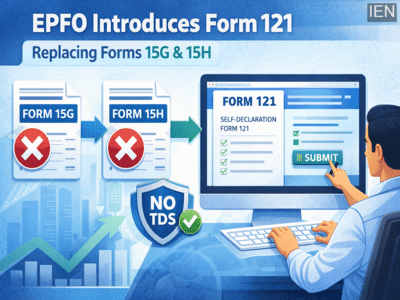
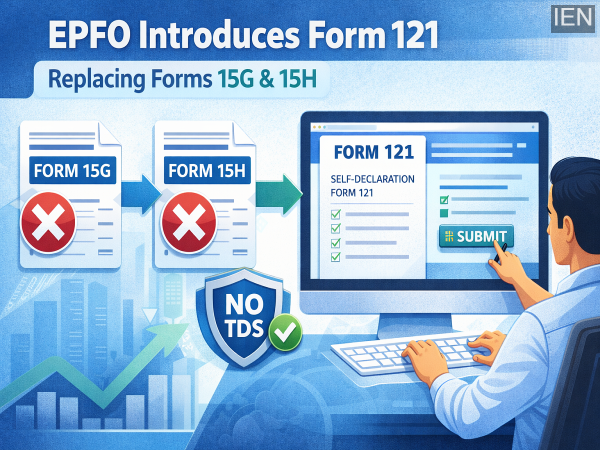
In a significant update for salaried individuals and provident fund subscribers, the Employees' Provident Fund Organisation has rolled out a new compliance rule effective April 1, 2026. The long-used Form 15G and Form 15H have now been discontinued and replaced with a single, streamlined declaration—Form 121.
This move comes in line with the implementation of the new income tax framework and aims to simplify the process of avoiding Tax Deducted at Source (TDS) for eligible taxpayers.
Form 15G and 15H Replaced by a Single Declaration
Earlier, taxpayers had to choose between two different forms:
- Form 15G for individuals below 60 years
- Form 15H for senior citizens
With the introduction of Form 121, this distinction has been removed. The new form acts as a unified self-declaration, eliminating confusion and reducing paperwork. Instead of multiple forms, eligible individuals now need to submit only one declaration.
Who Needs to Submit Form 121?
Form 121 is not mandatory for everyone. It is specifically designed for individuals and entities that meet certain conditions:
- Resident individuals (irrespective of age)
- Hindu Undivided Families (HUFs)
- Taxpayers whose total estimated income results in zero tax liability
If your income falls below the taxable threshold and no tax is payable, submitting this form ensures that institutions like EPFO or banks do not deduct TDS from your income.
Who Is Not Eligible for Form 121?
Not all taxpayers can take advantage of this facility. The following categories are excluded:
- Companies and corporate entities
- Partnership firms
- Non-resident individuals (NRIs)
This restriction ensures that the system remains transparent and is used only by eligible resident taxpayers.
What Is Form 121 and Why It Matters
Form 121 is essentially a self-declaration document, where the taxpayer confirms that their total annual income will remain below the taxable limit.
Once submitted correctly:
- No TDS is deducted by EPFO, banks, or other financial institutions
- It improves cash flow, especially for individuals with lower income
- It reduces the need for claiming refunds later
This makes it particularly useful for pensioners, small earners, and those with limited taxable income.
Unique Identification Number (UIN) System Introduced
Each submitted Form 121 will be assigned a Unique Identification Number (UIN) by the deductor (such as EPFO or a bank).
The UIN will include:
- A sequence number
- Tax year details
- TAN (Tax Deduction Account Number)
This system enhances traceability and transparency, ensuring proper record-keeping and validation of declarations.
What Happens to Old Forms Submitted After April 1?
If a taxpayer has submitted Form 15G or 15H after April 1, 2026, it will not be outright rejected. However, they will be required to update their declaration using Form 121.
This transitional approach ensures a smoother shift to the new system without causing inconvenience to taxpayers.
Technology-Driven and User-Friendly Upgrade
One of the key highlights of Form 121 is its digital-first design. The new form includes:
- Auto-fill features to reduce manual entry
- Real-time verification to minimize errors
- Easy-to-use tools like dropdown menus and date pickers
- Integration with databases and APIs for faster processing
These enhancements make the form more efficient and accessible, aligning with India’s broader push toward digital governance.
What This Change Means for Taxpayers
The introduction of Form 121 reflects a broader shift toward simplified and technology-driven tax compliance. By replacing multiple forms with a single declaration, the system becomes easier to understand and use.
For taxpayers, the key takeaway is clear:
If your income results in zero tax liability, submitting Form 121 on time can help you avoid unnecessary TDS deductions and improve your financial liquidity.
Final Word:
While the new form simplifies the process, accuracy and eligibility remain crucial. Taxpayers should ensure that all details are correctly declared to avoid compliance issues later.
Contact to : xlf550402@gmail.com
Copyright © boyuanhulian 2020 - 2023. All Right Reserved.