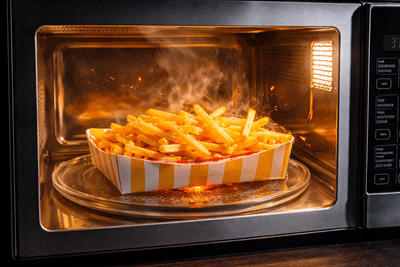
Fried foods remain widely popular across the world, largely because of their taste and texture. Crisp exteriors and soft interiors make items like French fries especially appealing. At the same time, their high oil content is often linked to health concerns such as obesity and hypertension. This creates a clear challenge for food scientists and manufacturers. Consumers want healthier options, but they also expect the same flavour and crunch. Finding a way to reduce fat without compromising quality has proven difficult.
According to ScienceDaily, researchers at the University of Illinois Urbana-Champaign are now exploring a method that could help address this issue. Their work focuses on microwave frying , a technique that combines conventional frying with microwave heating. Early findings suggest that this hybrid approach may reduce oil absorption while still maintaining the texture people expect from fried foods.
How microwave frying works differently from traditional frying
Traditional frying relies on heat moving from the outside of the food towards the centre. This creates a crisp outer layer, but it also allows oil to enter as moisture escapes. The process is well understood and widely used.
This technique of frying using the microwave oven provides energy. It penetrates the food substance and generates energy in the form of heat due to the movement of water molecules. It shows that the heating process occurs both internally and externally.
For this experiment, the researchers made use of a specially constructed microwave fryer. It was used at two different frequencies – 2.45 gigahertz and 5.8 gigahertz. These are frequencies similar to those used in regular microwaves; however, this was tailored specifically for experiments.
The potatoes used in the experiment were prepared using a particular formula. The formula comprised peeling, cutting, blanching, adding salt, and frying the potatoes using soybean oil at 180°C. Several factors were considered during the procedure.
How microwave frying limits oil absorption in food
Frying involves more than just heat. It also depends on how moisture and pressure change inside the food. At the beginning, the potato structure contains a high amount of water. This leaves little space for oil to enter. As cooking continues, the water begins to evaporate, creating empty spaces. These spaces generate negative pressure, which draws oil into the food.
Microwave heating appears to alter this process. Because heat is generated throughout the food, it promotes faster vapour formation. This helps maintain positive pressure inside the structure for a longer period.
Positive pressure pushes outward, which limits oil entry. Negative pressure pulls oil inward, increasing absorption. By extending the period of positive pressure, microwave frying reduces the overall amount of oil that enters the food.
Why combining microwave and traditional frying improves texture
The findings indicate that microwave frying can help in reducing oil content as well as decreasing cooking time. Water loss occurs at a faster rate, and the internal structure undergoes transformation in a controlled manner. However, microwave frying alone cannot deliver the required crispness. Instead, the food becomes soft after undergoing such a process.
In light of this information, the scientists suggest using microwave heating along with conventional frying. While the former process will help form a crispy layer, the latter process will ensure that less oil is absorbed inside the food items.
Contact to : xlf550402@gmail.com
Copyright © boyuanhulian 2020 - 2023. All Right Reserved.