Contractors are running continuous overtime, raising wages by up to 40%, and paying newly recruited workers standby pay just to keep them on the books.
Dang Xuan Minh, a representative of contractor AIT, said his firm is in the finishing stretch on the 220kV Phu Quoc substation, one of three power projects that must come online before APEC 2027 in November next year. He has about 90 workers on site and needs 260 before the rainy season begins.
“At this stage we’re not calculating profit or loss. We have to find people any way we can,” he said. “Phu Quoc right now is one massive construction site. The competition for workers is intense and local labor is limited.”
To keep crews coming, AIT has been recruiting in Vietnam’s central provinces, screening candidates only for basic physical fitness. Workers are kept on retainer with standby pay even when there is no work, then sent to the island when construction intensifies.
The contractor covers travel, accommodation and meals, and has pushed daily wages 30-40% above contract levels, to around VND800,000 (US$30) per day. Minh said labor rates are now far above what AIT assumed when it signed on, but the schedule leaves no room to hesitate.
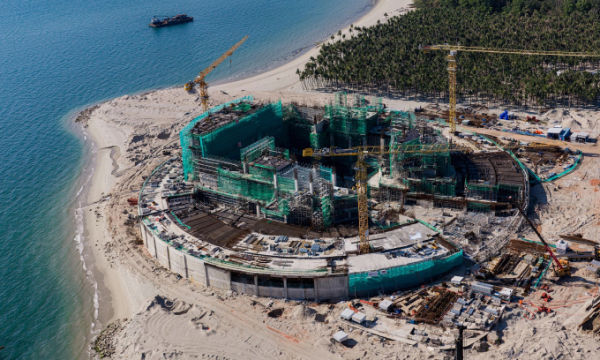
The APEC Convention and Exhibition Center under construction in Phu Quoc Island, southern Vietnam, March 2026. Photo by Phuong An |
The substation is a relatively small job.
An Giang Province, which absorbed Phu Quoc in Vietnam’s 2025 administrative merger, is simultaneously advancing 21 projects tied to the summit.
The centerpiece, the APEC Convention and Exhibition Center, is a Sun Group-led development with a total floor area of 152,166 sq.m. Its 11,050 sq.m main hall spans 81 m without a single pillar, 830 sq.m larger than the 10,220 sq.m Caesars Forum in Nevada that currently holds the record. The complex also includes a press center designed for 4,000 reporters, and is intended to anchor Phu Quoc’s long-term MICE tourism strategy.
A representative of one contractor on the convention center said its current workforce meets only 30-40% of demand as workloads climb. The rest has to be brought in, mostly from Ho Chi Minh City and other southern provinces. The contractor has built on-site barracks, subsidized travel, provided meals, and added night-shift allowances, but recruitment remains difficult.
Fewer young Vietnamese are choosing heavy construction work, and the simultaneous rollout of multiple major projects has driven competition for skilled labor sharply higher. Phu Quoc’s isolation from the mainland, its elevated cost of living, and lingering concerns over delayed payments from some subcontractors in the past all push many workers toward projects closer to home.
To stay on schedule, the sites run three continuous shifts, with the night shift accounting for about 30% of the workforce. At peak, a single contractor at the convention center can deploy 2,400 to 2,700 people when structural work, finishing, and mechanical-and-electrical systems advance in parallel.
Hoang Khac Ky, head of construction at the APEC Project Management Board under Sun Group, said the rough construction phase has kept more than 2,000 workers on site and is over 90% complete. As the project moves into finishing, demand could climb to 3,000-4,000 workers, most of them skilled tradesmen.
“Contractors are pushing everything they have into these last two months of dry weather,” he said.
At the nearby Phu Quoc airport, where a new runway, VIP terminal, and Terminal 2 are being built, about 4,000 workers are on site every day, and the project needs 2,000 more. Le Minh Thuan, head of infrastructure for the airport expansion at Sun Group, said the pressure is not just the numbers but the narrow pre-dawn windows when work can happen without disrupting commercial flights.
Sun Group said overall progress across its APEC projects remains on track, but pressure is mounting with only 9-15 months until completion. Contractors have roughly two months of dry weather in April and May to accelerate before Phu Quoc’s rainy season, which runs from May to October. A company representative said the labor shortage is one of four major bottlenecks, alongside site clearance, underground infrastructure, and materials.
To ease the strain, Sun Group has built prefabricated housing so most workers have free accommodation. Long-term workers receive bonuses and subsidized plane tickets home. Those who worked through the Lunar New Year earned about VND1 million ($38) a day in bonus pay. Workers with extended tenure also get free medical care, with support payments transferred directly.
Some contractors have proposed a mechanism to allow the hiring of foreign workers, arguing that domestic supply can no longer match the demands of multiple simultaneous megaprojects.
Contact to : xlf550402@gmail.com
Copyright © boyuanhulian 2020 - 2023. All Right Reserved.