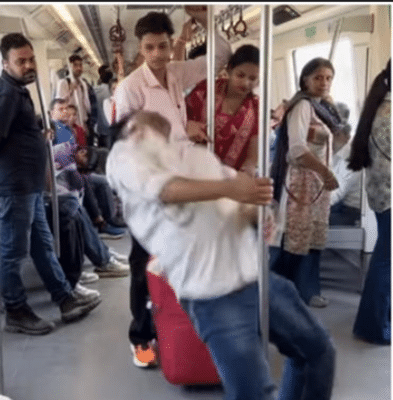
Man Dances in Delhi Metro Passengers' Reactions Shock
What looks like entertainment to one person can feel like discomfort to another. A viral video from the Delhi Metro shows a man dancing passionately to Teri Deewani inside a crowded coach. At first, it seems harmless just music, just expression. But as the performance continues, something shifts. Passengers begin reacting. Some smile, others freeze, unsure how to respond. And suddenly, a simple dance becomes a deeper question where do we draw the line between personal expression and public intrusion?
WHEN PUBLIC SPACE BECOMES A STAGE

Public transport is designed for convenience, not performance. Yet, social media has changed how people see these spaces. What was once a quiet commute is now becoming a potential stage for content. In this case, the dancer used poles, space, and movement as if performing on a set. But unlike a stage, a metro coach has no audience by choice. This creates a subtle conflict where one person’s expression enters someone else’s personal space without permission.
THE SILENT REACTIONS THAT SAY EVERYTHING
The most powerful part of the video is not the dance it’s the reactions. Some passengers smile, finding it entertaining. Others look away, clearly uncomfortable. A few shift positions to avoid contact. No one says anything, yet everything is communicated through body language. This silence reflects a common social reality people often tolerate discomfort in public spaces rather than confront it. The video captures this unspoken tension perfectly.
THE VIRAL CONTENT MINDSETToday, virality is a goal. Many creators push boundaries to stand out. Public performances like this are often designed to capture attention quickly. But in doing so, the line between creativity and consideration can blur. The focus shifts from “Is this appropriate?” to “Will this go viral?” This mindset is shaping a new kind of behavior where reactions matter more than responsibility.
ENTERTAINMENT VS PERSONAL SPACEEntertainment is subjective. What one person enjoys, another may find intrusive. In a confined space like a metro, personal boundaries are already limited. Adding an unexpected performance can amplify discomfort. The issue is not expression it is impact. When actions start affecting others physically or emotionally, it becomes more than just entertainment. It becomes a question of public etiquette.
A TREND THAT IS GROWING FASTThis is not an isolated incident. Similar videos are appearing more frequently across public transport systems. The trend is growing because it works it gets views, shares, and attention. But with growth comes responsibility. If left unchecked, such behavior could normalize disruption in shared spaces. The real question is not whether it will stop but how society will adapt to it.
Unlock insightful tips and inspiration on personal growth, productivity, and well-being. Stay motivated and updated with the latest at My Life XP.
Frequently Asked Questions (FAQs)
1. What exactly happened in the viral metro video?
A man performed an expressive dance inside a crowded coach of the Delhi Metro to Teri Deewani, moving around passengers and using poles as props.
2. Why did people react so differently?
Because public spaces are shared. Some saw creativity and spontaneity, while others felt their personal space was being disturbed in a confined environment.
3. Is this kind of public performance allowed?
It depends on context. If it disrupts others, causes discomfort, or creates safety risks, it may violate public conduct rules.
4. Why are such videos becoming common?
Social media rewards attention. Unusual or bold acts in everyday spaces often go viral, encouraging more people to try similar content.
5. What is the main issue highlighted here?
The balance between personal expression and public comfort. What you do in a shared space affects people who didn’t choose to be part of it.
WHEN PUBLIC SPACE BECOMES A STAGE
Mixed emotions—amusement, discomfort, and confusion
Public transport is designed for convenience, not performance. Yet, social media has changed how people see these spaces. What was once a quiet commute is now becoming a potential stage for content. In this case, the dancer used poles, space, and movement as if performing on a set. But unlike a stage, a metro coach has no audience by choice. This creates a subtle conflict where one person’s expression enters someone else’s personal space without permission.
THE SILENT REACTIONS THAT SAY EVERYTHING
View this post on Instagram
A post shared by btw_swastik (@btw_swastik_02)
The most powerful part of the video is not the dance it’s the reactions. Some passengers smile, finding it entertaining. Others look away, clearly uncomfortable. A few shift positions to avoid contact. No one says anything, yet everything is communicated through body language. This silence reflects a common social reality people often tolerate discomfort in public spaces rather than confront it. The video captures this unspoken tension perfectly.
THE VIRAL CONTENT MINDSETToday, virality is a goal. Many creators push boundaries to stand out. Public performances like this are often designed to capture attention quickly. But in doing so, the line between creativity and consideration can blur. The focus shifts from “Is this appropriate?” to “Will this go viral?” This mindset is shaping a new kind of behavior where reactions matter more than responsibility.
ENTERTAINMENT VS PERSONAL SPACEEntertainment is subjective. What one person enjoys, another may find intrusive. In a confined space like a metro, personal boundaries are already limited. Adding an unexpected performance can amplify discomfort. The issue is not expression it is impact. When actions start affecting others physically or emotionally, it becomes more than just entertainment. It becomes a question of public etiquette.
A TREND THAT IS GROWING FASTThis is not an isolated incident. Similar videos are appearing more frequently across public transport systems. The trend is growing because it works it gets views, shares, and attention. But with growth comes responsibility. If left unchecked, such behavior could normalize disruption in shared spaces. The real question is not whether it will stop but how society will adapt to it.
Unlock insightful tips and inspiration on personal growth, productivity, and well-being. Stay motivated and updated with the latest at My Life XP.
Frequently Asked Questions (FAQs)
1. What exactly happened in the viral metro video?
A man performed an expressive dance inside a crowded coach of the Delhi Metro to Teri Deewani, moving around passengers and using poles as props.
2. Why did people react so differently?
Because public spaces are shared. Some saw creativity and spontaneity, while others felt their personal space was being disturbed in a confined environment.
3. Is this kind of public performance allowed?
It depends on context. If it disrupts others, causes discomfort, or creates safety risks, it may violate public conduct rules.
4. Why are such videos becoming common?
Social media rewards attention. Unusual or bold acts in everyday spaces often go viral, encouraging more people to try similar content.
5. What is the main issue highlighted here?
The balance between personal expression and public comfort. What you do in a shared space affects people who didn’t choose to be part of it.
Contact to : xlf550402@gmail.com
Copyright © boyuanhulian 2020 - 2023. All Right Reserved.