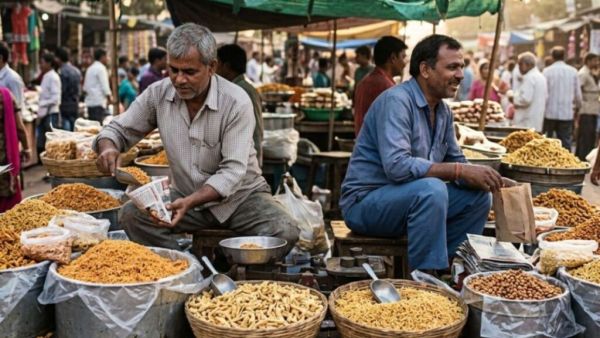
On every street corner you will see people selling gram, namkeen or peanuts. Many times in shops or sometimes on carts. Just 5 or 10 rupees. Small shopkeepers earn money daily from this business and run their household. There are millions of such small shopkeepers in India who account for 40 to 56 percent of the Indian snacks market. These shopkeepers who sell snacks run such a big industry without any advertisement and without any big company. The entire snacks market of India in 2025 will be around Rs 50,590 crore. Out of this, Rs 20,000 to 25,000 crore goes to these small shopkeepers.
Lay’s, Kurkure, Haldiram’s, all these are big names in the snacks market. In terms of money, their share is 60 percent, but in the amount of food sold daily, the share of open and nameless snack packets is 56 percent. This means that big brands are ahead in price. For example, Haldirams earns Rs 8,700 crore a year. Balaji Wafers earned Rs 6,500 crore last year. Even today, in small towns and villages, open namkeen and open bhujia are sold more.
How do they make money?
The formula for companies selling snacks in the open is very simple. There is less expenditure and more earning. A big company has to advertise, do big packaging, run a big office. This all adds up to the price of the product. These reasons increase the prices of products of big companies. At the same time, small manufacturers do not have to spend on branding and good packaging etc. The raw material comes from the nearby market, the production is done at home, the packaging is in simple polythene and only their family members work in making it. The cost of production per kg in a small unit is around Rs 200 and is sold at Rs 600 to Rs 800 per kg.
power of local business
These small companies do not operate in the entire country, but are very strong in their surrounding area or district. They have direct interaction with the shopkeeper and earn more by selling their goods to the shopkeeper. These people create the same taste which is liked by the people there which big brands are not able to provide. All their transactions are done in cash so money never gets stuck. When inflation increases and people are unable to buy expensive goods, then these become everyone’s first choice as cheap and good goods. For this reason, even big companies cannot stand in front of them.
What will happen next?
Nowadays, government rules are becoming stricter and people have also started paying more attention to cleanliness. Also, the increasing trend of purchasing goods online has increased some pressure on these small brands. Their village market is very big now and there is no other option for low priced goods there. By 2034 this market will exceed Rs 1 lakh crore. There will be good space for both big brands and small local brands.
Contact to : xlf550402@gmail.com
Copyright © boyuanhulian 2020 - 2023. All Right Reserved.