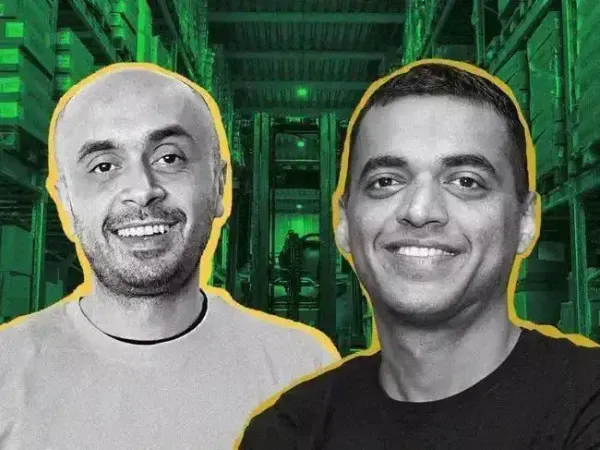
Eternal CEO Albinder Dhindsa and founder and vice chairman Deepinder Goyal
Eternal, which operates food and grocery delivery platforms Zomato and Blinkit, reported a threefold year-on-year jump in operating revenue for the March quarter to Rs 17,292 crore, alongside a 4.5 times rise in net profit to Rs 174 crore, as quick commerce margins improved.
The Gurgaon-based company’s founder and vice chairman Deepinder Goyal said it has crossed $10 billion in net order value (NOV) – defined as gross order value (GOV) minus discounts – across its business-to-consumer (B2C) verticals that include going-out business District and B2B grocery arm Hyperpure.
This figure is expected to double over the next two years, he said in a letter to shareholders.
Eternal chief executive Albinder Singh Dhindsa, though, flagged a likely moderation in quick commerce growth – now the company’s largest vertical – as competition intensifies.
Compared with a 104% compound annual growth rate (CAGR) between FY23 and FY26, Blinkit expects NOV to grow by over 60% over the next three years, he said.
In the March quarter, Blinkit’s NOV rose 95% on year, at the upper end of brokerage estimates of 67-99%.
“That translates into the business growing to more than four times its current scale in three years,” said Dhindsa who replaced Goyal as CEO in February. “Quick commerce today is still concentrated in the top 15-20 cities and across a relatively narrow set of categories. The headroom for growth in geography, assortment and frequency is substantial,” he added.
Eternal’s fourth-quarter revenue growth was driven by Blinkit’s shift from a marketplace to an inventory-led model. Instead of recognising only commissions, the company now records the full value of sales in its topline. On a like-for-like basis, revenue grew 64%.
Blinkit also reported its second consecutive quarter of operating profitability, with adjusted Ebitda of Rs 37 crore, compared with a loss of Rs 178 crore a year earlier. In the October-December quarter, it had posted an operating profit of Rs 4 crore.
This comes at a time when stock market investors are pushing quick commerce firms to prioritise profitability after several quarters of elevated cash burn.
In a December interview with ET, Dhindsa had said public market appetite for funding quick commerce expansion through balance-sheet capital is limited, adding that the sector will soon face tougher questions on sustainable growth.
He cautioned that intensifying competition could weigh on Blinkit’s outlook. “High competition can have an adverse impact at times, such as now, when aggressive discounting is driving poor-quality growth centred on select low-margin SKUs,” he said. “Over the longer term, however, healthy competition will support both our growth and that of the broader market.”
Food delivery gathers pace
According to Goyal, Eternal’s overall operating profit is projected to exceed $1 billion by FY29, up from around $150 million in FY26.
Its food delivery arm Zomato continued to accelerate in the March quarter, with NOV rising 19% year-on-year to Rs 9,757 crore.
“Growth has been accelerating over the last three quarters after bottoming out in Q1FY26. We believe the improvement is structural, driven by deliberate interventions to expand the addressable market into more price-sensitive segments,” Goyal said.
He noted that Zomato lowered the minimum order value for free delivery to Rs 99 for Gold members and stepped up targeted activation for budget-conscious customers. “The results have been encouraging – order volume growth is being driven by monthly transacting customer (MTC) growth, both from new users and higher frequency among existing budget-conscious customers,” he said.
However, chief financial officer Akshant Goyal said the company does not plan to follow Swiggy in launching a budget-focused offering like Toing. “We’re not sure what problem that solves for either customers or restaurants,” he said.
Also Read: Zomato founder Deepinder Goyal downplays impact of LPG shortage on business
AI impact
Eternal's founder also pushed back against concerns that artificial intelligence (AI) chat interfaces could disrupt food delivery and quick commerce, arguing instead that the technology could strengthen Eternal’s moat by expanding its user base.
In his note, he drew a parallel with Google’s attempts to bring transactions like travel bookings, shopping and food ordering into its ecosystem.
“They had the largest demand surface on earth – billions of searches a day – and the strongest distribution advantage in history. Yet Booking.com, Expedia and Amazon still exist. Vertical apps that consumers built habits around didn’t get displaced,” he wrote.
“General-purpose interfaces are good for general queries but poor for complex, high-frequency, habitual transactions,” he added, noting that frequent users are unlikely to shift from apps like Zomato or Blinkit to chat-based interfaces.
Eternal’s shares, which fell as much as 4% during Tuesday’s trade, recovered nearly 6% after the results announcement. They ended 0.7% lower at Rs 253.80 on the BSE.
The Gurgaon-based company’s founder and vice chairman Deepinder Goyal said it has crossed $10 billion in net order value (NOV) – defined as gross order value (GOV) minus discounts – across its business-to-consumer (B2C) verticals that include going-out business District and B2B grocery arm Hyperpure.
This figure is expected to double over the next two years, he said in a letter to shareholders.
Eternal chief executive Albinder Singh Dhindsa, though, flagged a likely moderation in quick commerce growth – now the company’s largest vertical – as competition intensifies.
Compared with a 104% compound annual growth rate (CAGR) between FY23 and FY26, Blinkit expects NOV to grow by over 60% over the next three years, he said.
In the March quarter, Blinkit’s NOV rose 95% on year, at the upper end of brokerage estimates of 67-99%.
“That translates into the business growing to more than four times its current scale in three years,” said Dhindsa who replaced Goyal as CEO in February. “Quick commerce today is still concentrated in the top 15-20 cities and across a relatively narrow set of categories. The headroom for growth in geography, assortment and frequency is substantial,” he added.
Eternal’s fourth-quarter revenue growth was driven by Blinkit’s shift from a marketplace to an inventory-led model. Instead of recognising only commissions, the company now records the full value of sales in its topline. On a like-for-like basis, revenue grew 64%.
Blinkit also reported its second consecutive quarter of operating profitability, with adjusted Ebitda of Rs 37 crore, compared with a loss of Rs 178 crore a year earlier. In the October-December quarter, it had posted an operating profit of Rs 4 crore.
This comes at a time when stock market investors are pushing quick commerce firms to prioritise profitability after several quarters of elevated cash burn.
In a December interview with ET, Dhindsa had said public market appetite for funding quick commerce expansion through balance-sheet capital is limited, adding that the sector will soon face tougher questions on sustainable growth.
He cautioned that intensifying competition could weigh on Blinkit’s outlook. “High competition can have an adverse impact at times, such as now, when aggressive discounting is driving poor-quality growth centred on select low-margin SKUs,” he said. “Over the longer term, however, healthy competition will support both our growth and that of the broader market.”
Food delivery gathers pace
According to Goyal, Eternal’s overall operating profit is projected to exceed $1 billion by FY29, up from around $150 million in FY26.
Its food delivery arm Zomato continued to accelerate in the March quarter, with NOV rising 19% year-on-year to Rs 9,757 crore.
“Growth has been accelerating over the last three quarters after bottoming out in Q1FY26. We believe the improvement is structural, driven by deliberate interventions to expand the addressable market into more price-sensitive segments,” Goyal said.
He noted that Zomato lowered the minimum order value for free delivery to Rs 99 for Gold members and stepped up targeted activation for budget-conscious customers. “The results have been encouraging – order volume growth is being driven by monthly transacting customer (MTC) growth, both from new users and higher frequency among existing budget-conscious customers,” he said.
However, chief financial officer Akshant Goyal said the company does not plan to follow Swiggy in launching a budget-focused offering like Toing. “We’re not sure what problem that solves for either customers or restaurants,” he said.
Also Read: Zomato founder Deepinder Goyal downplays impact of LPG shortage on business
AI impact
Eternal's founder also pushed back against concerns that artificial intelligence (AI) chat interfaces could disrupt food delivery and quick commerce, arguing instead that the technology could strengthen Eternal’s moat by expanding its user base.
In his note, he drew a parallel with Google’s attempts to bring transactions like travel bookings, shopping and food ordering into its ecosystem.
“They had the largest demand surface on earth – billions of searches a day – and the strongest distribution advantage in history. Yet Booking.com, Expedia and Amazon still exist. Vertical apps that consumers built habits around didn’t get displaced,” he wrote.
“General-purpose interfaces are good for general queries but poor for complex, high-frequency, habitual transactions,” he added, noting that frequent users are unlikely to shift from apps like Zomato or Blinkit to chat-based interfaces.
Eternal’s shares, which fell as much as 4% during Tuesday’s trade, recovered nearly 6% after the results announcement. They ended 0.7% lower at Rs 253.80 on the BSE.