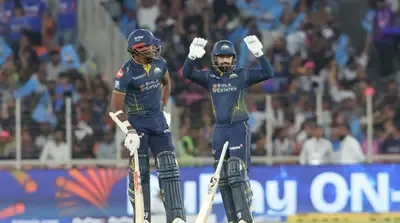
For too long India's T20 strength has been characterized by huge totals big sixes and no fear of playing strokes (an ethos heavily dominated by the IPL) but the narrative in the 2026 edition has been slightly different and India's batting approach has once again come under the scanner in tougher overseas conditions.
The encounter between Delhi Capitals and Royal Challengers Bengaluru in Delhi was a stark illustration of the swift demise that can occur when a pitch offers the slightest advantage to bowlers. Delhi were skittled out to 8/6 within 3.5 overs and ended the Powerplay at a record low of 13/6. They were eventually bowled out for 75 with Josh Hazlewood and Bhuvneshwar Kumar proving unplayable under the conditions.
Such contests have not been confined to Delhi. Lucknow has found 160 a tough target to chase, and batting has proved similarly difficult against quality bowling units helmed by Mohammed Siraj, Kagiso Rabada and Jason Holder. Neither are particularly raging conditions, just surfaces with enough life to test technique.
Also Read | New Zealand Pick T20 World Cup Squad, 3 Legends Confirm Final Appearance
A focus on technique and adaptation
With major tournaments approaching outside the Indian subcontinent, including the 2027 ODI World Cup in South Africa and the 2028 T20 World Cup in Australia and New Zealand, these performances cannot be overlooked. The typical Indian batting approach has developed over years spent in subcontinent conditions where massive scores are often the norm.
The importance of such matches was underscored by former selector Devang Gandhi.
Gandhi said:
“It’s important that these low-scoring matches are not discouraged. The curator must not be under pressure if his surface has produced a low-scoring game here and there. The selectors see how batters adapt to challenging conditions. Look at Virat Kohli, how well he batted in similar conditions. I'm sure the selectors have an eye out for that when they plan for the future,"
Delhi captain Axar Patel also highlighted the significance of building strong foundations.
Axar Patel Said:
“The franchises do hold camps round the year. It's a personal choice for the young uncapped players to decide what drills they would like to do more. But I believe one should focus on technique and the foundation of batting. You can't sustain power-hitting if you don't have a strong foundation."
The structure of the league itself is another element that must be considered. In a 10-team IPL, bowling attacks are inherently more dispersed. Former India player Deep Dasgupta observed
Dasgupta said:
"One has to factor that in while judging a batter's season. GT, RR, LSG and RCB look to have comparatively potent attacks. How batters are reacting to these bowlers holds the key since you will not get 250-plus conducive T20 pitches in SENA countries. The planning has to be for the ODI World Cup in South Africa."
While these low-scoring games have been infrequent they serve as a crucial reminder: if India is to triumph overseas, adapting to diverse conditions will prove as vital as compiling big scores back home.
Contact to : xlf550402@gmail.com
Copyright © boyuanhulian 2020 - 2023. All Right Reserved.