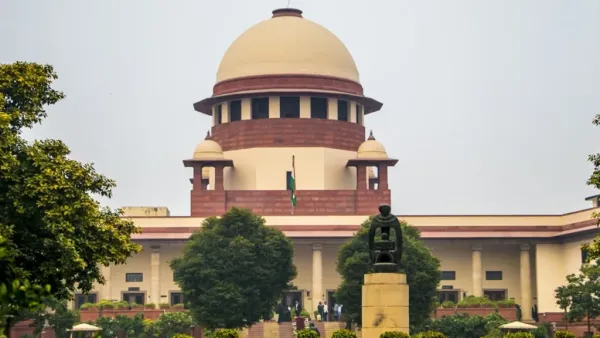
New Delhi. The Supreme Court on Wednesday said an important thing on the issue of religion and reform during the hearing in the Sabarimala temple case. The Supreme Court said that it cannot eliminate any religion in the name of reform. The Supreme Court also said that issues to faith and conscience cannot be made the subject of judicial debate. The Constitution bench of nine judges headed by CJI Surya Kant also raised the question that if a person from North India is an atheist, then how can he demand the right to enter the Sabarimala temple.
The Supreme Court said that while deciding the right to enter temples, it has to be seen whether it is claimed by a believer or an atheist. The Constitution Bench also said the important thing that some things have become an essential part of religion with time. Justice BV Nagarathna, member of the Constitution bench, said that different states have made laws like Uniform Civil Code (UCC) to regulate marriage and inheritance rights under the law. He said that when the society is completely ready, the Parliament will also make the UCC. The bench had asked the question whether if the government fails to create UCC, can the court do so?

The Supreme Court also asked whether the court can gradually bring equality provisions in matters of religious freedom? Can the criterion of equality be applied to completely eliminate the integral practice of a religion? At the same time, on behalf of the women who filed the petition for the right to enter the Sabarimala temple, senior lawyer Indira Jaisingh said that every state has made laws for entry into the temples. If someone wants to claim his rights, he has to obey those laws. On this, Justice Jaimalya Bagchi said that there is no such law regarding non-Hindu religious places. Can the court issue directions to those sites also to maintain parity or should it wait for the legislature to take action?

Justice Nagarathna, who was part of the bench, said that religion should not be hollowed out in the name of reform. He said that those customs and traditions which have been going on for centuries should not be disturbed. To do so would be like destroying religion. The court does not want to be a part of it. Justice Nagarathna said that issues of conscience cannot become a matter of debate in a secular court. Justice Nagarathna said that it was the practice of Sabarimala temple that women between 10 and 50 years of age should not enter there. On this, Indira Jaisingh said that this practice has no religious basis. Jaising said the ban on women’s entry into the Sabarimala temple comes during the most productive and creative period of their lives.