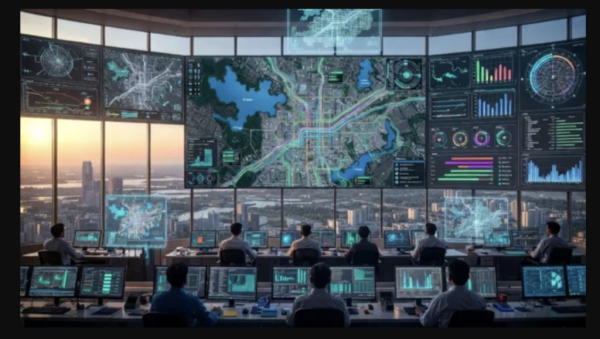
Bengaluru is set to launch one of Asia’s largest AI-powered command centres to manage its water and sewage systems. Developed by the Bangalore Water Supply and Sewerage Board, the Integrated Intelligent Water and Sewerage Management Centre (SCADA) marks a significant shift toward data-driven governance.
Located at Shimsha Bhavan in Jayanagar, the centre is expected to be inaugurated soon and will serve as the nerve centre for the city’s water infrastructure.
Real-Time Monitoring of Water Systems
The command centre will monitor Bengaluru’s entire drinking water and sewerage network in real timeincluding supply from the Cauvery Stage 5 project, which delivers about 775 million litres per day to over 110 villages.
It is connected to major water treatment plants, reservoirs, and sewage systems, enabling officials to track operations continuously and respond quickly to any disruptions.
AI to Detect Leaks and Reduce Water Loss
One of the most powerful features of the system is its ability to instantly detect pipeline leaks using artificial intelligence. Bengaluru currently loses nearly 28% of its water due to leakage or theftmaking this a critical upgrade.
By identifying leaks in real time, the system can significantly reduce “non-revenue water” losses, improving efficiency and saving resources.
Predicting Water Demand with Precision
Beyond monitoring, the platform uses AI to predict water demand across different parts of the city. This allows authorities to plan supply more efficiently, especially during peak demand seasons.
The system integrates IoT sensors, GIS mapping, and smart meters to create a data-rich ecosystem, enabling predictive maintenance and early warnings for potential failures.
Ensuring Water Quality and Safety
The command centre also tracks water quality parameters such as chlorine levels, pH, turbidity, and total dissolved solids (TDS). If contamination is detected, alerts are generated instantly, allowing quick corrective action.
Additionally, all sewage treatment plants are connected to the system, ensuring compliance with environmental standards and monitoring biogas generation.
A Step Toward a “Digital Twin” City
Officials say the project lays the foundation for creating a digital twin of Bengaluru’s water network—a virtual model that can simulate and optimize operations.
This could revolutionize how cities manage resources, moving from reactive problem-solving to predictive and preventive governance.
Why This Matters
With rising population and water stress, Bengaluru has been struggling with supply-demand gaps. This AI-driven command centre represents a major step toward smarter, more sustainable urban water management.
It also sets a benchmark for other Indian cities looking to integrate AI into public infrastructure at scale.
Contact to : xlf550402@gmail.com
Copyright © boyuanhulian 2020 - 2023. All Right Reserved.