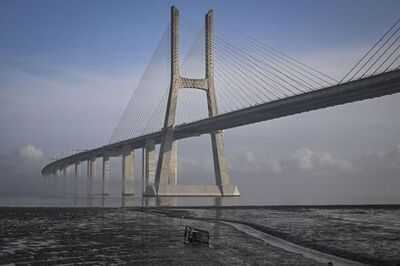
There are some engineering projects so vast they almost seem unreal - and one of them sits just outside Lisbon. Europe's second longest bridge, stretching so far across the water that on misty days drivers reportedly struggle to see the other side, is around 60 times the length of London Bridge. The Vasco da Gama Bridge in is one of the most impressive engineering structures on the continent.
Crossing the wide Tagus River, the bridge measures around 10 miles (17.2km) in total, making it the longest in the European Union and second only in Europe to the Crimean Bridge. It would take around eight minutes to drive over it at the speed limit of 75mph, though this is reduced to 56mph in poor weather.
- Moment brave police kick Golders Green stabbings suspect in head - 'drop the knife'
- Santander to pay £829 compensation to customers
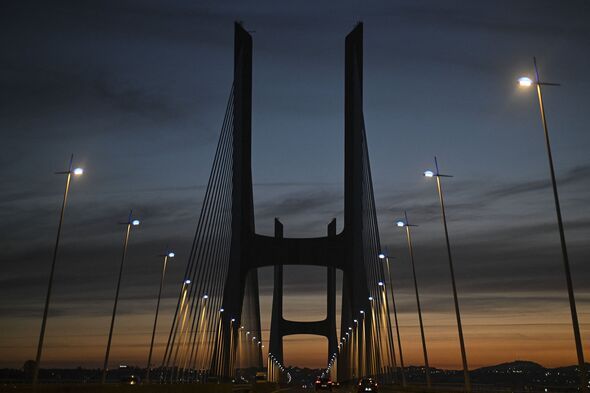
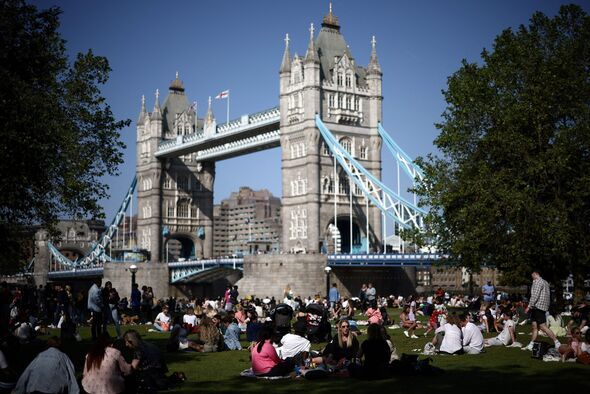
For perspective, London Bridge measures only a fraction of the Portuguese giant. At 940 feet (290m), it makes the Vasco da Gama Bridge roughly 60 times longer.
Named after legendary Portuguese explorer Vasco da Gama, the bridge officially opened on March 29, 1998, in time for Expo 98, the world fair held in Lisbon marking 500 years since da Gama's voyage to India by sea.
Built at a reported cost of £746 million, the bridge was designed to solve a growing traffic problem in the Portuguese capital. Before it opened, much of the traffic moving between northern and southern Portugal had to pass through Lisbon and rely on the older 25 de Abril Bridge.
Despite its huge scale, the project took only around four years, with construction beginning in 1995. At peak times, around 3,300 workers were involved in the build.
Today, the bridge carries six lanes of traffic but there are no pedestrian or cycle routes, and drivers must pay a toll when they travel west.
Its central span alone reaches 420 metres, while the Central Viaduct stretches for nearly four miles and allows ships to pass below, according to Britannica.
It was built to withstand some extreme conditions, including winds of up to 155mph and earthquakes stronger than the devastating 1755 Lisbon quake, one of the most powerful in European history at an estimated magnitude of 8.5 to 9.0.
It was also designed with environmentally conscious features, such as inward-facing lighting designed to reduce disruption to birdlife and the surrounding Tagus estuary.
Vast, practical and surprisingly elegant, it remains one of Europe's greatest modern engineering achievements.
Contact to : xlf550402@gmail.com
Copyright © boyuanhulian 2020 - 2023. All Right Reserved.