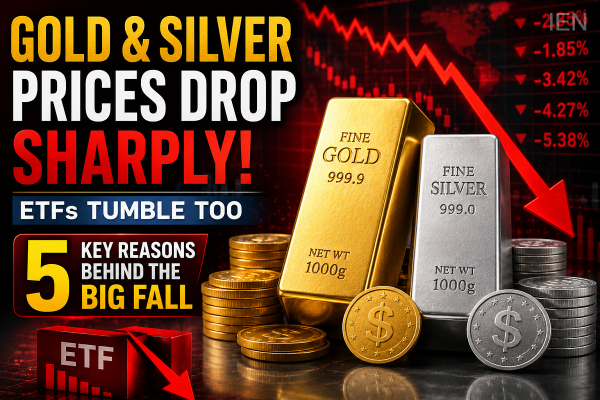
Precious metals witnessed a steep decline on Tuesday, with both gold and silver prices falling sharply across domestic and international markets. The correction was not limited to physical bullion alone, as exchange-traded funds (ETFs) linked to gold and silver also came under significant pressure. The sudden downturn has left many investors wondering whether this is a temporary correction or the beginning of a deeper trend.
Market experts point to a combination of monetary policy expectations, currency movements, investor behavior, and geopolitical developments as the primary reasons behind the sharp fall in precious metal prices.
Gold and Silver Record Significant Losses
Gold prices dropped by more than 1% during intraday trade, while silver registered an even steeper decline. The weakness was visible across major commodity exchanges, reflecting a broader shift in investor sentiment.
Silver experienced heavier selling pressure compared to gold, highlighting the increased volatility often associated with the white metal. At the same time, gold and silver ETFs mirrored the losses seen in spot markets, indicating that institutional investors were also reducing exposure to precious metals.
The decline was not restricted to Indian markets. International bullion prices also moved lower, suggesting that global factors played a major role in triggering the sell-off.
Why Are Gold and Silver Falling?
Analysts believe that five major developments have combined to create downward pressure on precious metals.
1. Hawkish Signals from the US Federal Reserve
One of the biggest reasons behind the fall in gold and silver is the latest stance taken by the US Federal Reserve. Policymakers have continued to emphasize their commitment to controlling inflation, raising concerns that interest rates could remain elevated or even move higher in the coming months.
Higher interest rates generally reduce the attractiveness of non-yielding assets such as gold and silver because investors can earn better returns through fixed-income instruments.
2. Expectations of Additional Rate Hikes
Adding to market concerns, several financial institutions have projected further monetary tightening in the United States. Forecasts suggesting multiple rate increases over the next year have strengthened expectations that borrowing costs may stay higher for longer.
Such projections often encourage investors to shift funds away from precious metals and toward interest-bearing assets, resulting in lower demand for gold and silver.
3. Profit Booking After a Strong Rally
Gold and silver had delivered substantial gains over recent months, supported by geopolitical uncertainty, inflation concerns, and strong safe-haven demand.
Following the recent rally, many investors chose to lock in profits. This wave of profit-taking intensified selling pressure, especially in ETFs and other investment products linked to precious metals.
Market participants note that profit booking is a common occurrence after extended price increases and can lead to sharp short-term corrections.
4. Strengthening US Dollar
The movement of the US dollar is another important factor influencing precious metal prices. A stronger dollar makes gold and silver more expensive for buyers holding other currencies.
As the dollar gains strength, international demand for bullion can weaken, often resulting in lower prices. Recent gains in the US Dollar Index have therefore added another layer of pressure on gold and silver markets.
5. Easing Geopolitical Concerns
Precious metals are widely regarded as safe-haven assets during periods of uncertainty. However, when geopolitical risks begin to ease, investors often move funds into equities and other growth-oriented investments.
Recent developments indicating progress in diplomatic discussions between major global players have improved overall market sentiment. As risk appetite returned, demand for defensive assets such as gold and silver weakened.
What Should Investors Watch Next?
Market participants are now closely monitoring upcoming economic data, inflation trends, and statements from Federal Reserve officials. Any indication regarding future interest-rate decisions could significantly influence the direction of gold and silver prices.
While the recent decline has raised concerns, analysts suggest that long-term investors should focus on broader macroeconomic trends rather than short-term market volatility. Precious metals continue to play an important role in portfolio diversification, particularly during periods of economic uncertainty.
For now, the combination of higher rate expectations, a stronger dollar, profit booking, and reduced geopolitical tension has created a challenging environment for gold and silver. Whether the correction deepens or stabilizes will largely depend on future economic and policy developments across global markets.
Contact to : xlf550402@gmail.com
Copyright © boyuanhulian 2020 - 2023. All Right Reserved.