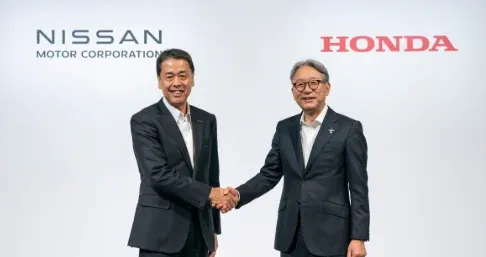
Honda and Nissan appear to be entering a decisive phase in their growing partnership, with both Japanese automakers making significant progress toward a technology-sharing agreement that could influence the future of their hybrid and electric vehicle portfolios.
Speaking during Honda’s annual shareholders’ meeting in Japan, President Toshihiro Mibe confirmed that discussions with Nissan have advanced considerably. While no formal agreement has been announced, he suggested that several aspects of the collaboration are nearing completion, indicating that an official announcement may arrive sooner than expected.
The development comes at a critical time for both companies as they face mounting pressure from rapidly expanding global EV manufacturers and increasing competition in software-defined vehicles.
Shared ECU to Form the Foundation
One of the first projects expected to emerge from the partnership is the development of a common electronic control unit (ECU), often described as the central computing system that manages a vehicle’s critical electronic functions.
Rather than each company building separate vehicle software architectures, Honda, Nissan, and Mitsubishi are reportedly working toward a unified ECU platform that can support multiple models across their respective lineups. The technology is expected to power both hybrid and fully electric vehicles.
Industry reports indicate that the shared platform could enter production around 2029 or 2030. Once the core software architecture is standardized, the companies would have greater flexibility to share additional technologies, reduce development costs, and accelerate vehicle launches.
Partnership Still Requires Final Approval
Although negotiations have made substantial progress, several commercial details remain unresolved. Discussions are continuing around development investments, intellectual property arrangements, and cost-sharing before the agreement can be finalized.
According to Mibe, the companies are approaching the partnership with a mutual objective of creating value for all participants rather than competing over ownership of individual technologies.
That collaborative approach reflects a broader trend within the automotive industry, where manufacturers are increasingly sharing platforms and software to offset the enormous investment required for next-generation mobility.
Renault’s Role Could Influence the Outcome
Despite the positive momentum, one important stakeholder still holds considerable influence over Nissan’s future decisions.
French automaker Renault continues to own a 15 percent voting stake in Nissan, giving it the ability to shape major strategic moves that require shareholder approval.
Recent reports suggest Renault may have played a role in opposing one of Nissan’s proposed board appointments, highlighting that its influence remains significant despite years of restructuring within the alliance.
Should Honda and Nissan pursue a deeper capital partnership in the future, shareholder approval will be essential, making Renault’s position an important factor to watch.
Honda Faces Growing Competitive Pressure
The urgency behind the partnership is also tied to Honda’s financial challenges.
The company recently reported an annual net loss of 423.9 billion yen for the financial year ending in March, marking one of the most difficult periods in its history. Rising development costs, intensifying EV competition, and changing market dynamics have increased pressure on traditional automakers to innovate faster while controlling expenses.
Mibe acknowledged that the next few years will be critical, warning that Honda’s four-wheel business must strengthen its competitiveness against rapidly emerging rivals.
A deeper partnership with Nissan could provide exactly that opportunity by allowing both companies to share technology investments, streamline software development, and bring new electrified vehicles to market more efficiently.
As the automotive industry shifts toward connected, software-driven vehicles, this collaboration could become one of the most significant strategic partnerships in Japan’s modern automotive landscape.
Contact to : xlf550402@gmail.com
Copyright © boyuanhulian 2020 - 2023. All Right Reserved.