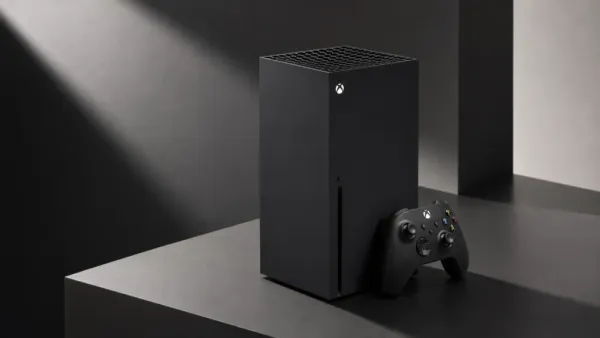
If you’re looking for a console that combines high-resolution gaming with fast loading and broad backward compatibility, the Xbox Series X remains Microsoft’s flagship Xbox hardware. The console is built around a custom AMD platform and is designed to deliver True 4K gaming, with support for frame rates of up to 120FPS in supported titles. Microsoft’s current Xbox Series X product page continues to position it as the company’s most powerful Xbox, while also highlighting features such as Quick Resume, Xbox Velocity Architecture, hardware-accelerated ray tracing, and compatibility with thousands of games.
Xbox Series X Performance and Hardware
At the heart of the Xbox Series X is a custom AMD Zen 2 CPU with eight cores clocked at up to 3.8GHz, or 3.6GHz with simultaneous multithreading. Graphics processing is handled by a custom RDNA 2 GPU rated at 12 teraflops, with 52 compute units running at 1.825GHz. Together, these components provide the processing foundation for Microsoft’s current-generation console performance targets.
The console includes 16GB of GDDR6 memory connected through a 320-bit bus. Microsoft divides the memory bandwidth between 10GB running at 560GB/s and another 6GB running at 336GB/s. This high-bandwidth memory configuration is designed to keep the CPU and GPU supplied with data while games process high-resolution assets and demanding visual effects.
Storage is another major part of the system. The standard Carbon Black Xbox Series X comes with a 1TB custom NVMe SSD, while Microsoft’s current lineup also includes a 1TB all-digital Robot White model and a 2TB Galaxy Black disc-drive edition. The SSD provides raw I/O throughput of 2.4GB/s, increasing to 4.8GB/s with hardware-assisted compression and decompression.
True 4K Gaming and Up to 120FPS
The Xbox Series X is designed around a True 4K gaming target, with supported games capable of reaching up to 120 frames per second. Actual resolution and frame rate depend on individual games, display hardware, and the settings selected by developers, but the console’s hardware is built to support high-refresh-rate gaming alongside high-resolution output.
The console also supports HDR, with Microsoft’s specifications listing capabilities up to 8K HDR. For compatible displays, HDMI 2.1 features include Auto Low Latency Mode and HDMI Variable Refresh Rate, while AMD FreeSync support can help maintain smoother gameplay by synchronising display refresh rates with the console’s output.
Hardware-accelerated ray tracing is another major feature. Xbox says games developed using the Series X|S development kit can take advantage of improved visuals, responsiveness, and loading performance, while ray tracing adds more realistic lighting, reflections, and other visual effects.
Quick Resume and Xbox Velocity Architecture
Raw hardware performance is only part of the Series X experience. Microsoft also developed the Xbox Velocity Architecture around the console’s custom SSD and software stack to reduce the amount of time players spend waiting for games to load.
Quick Resume is one of the most visible examples. It allows players to move between supported titles and return to games close to where they previously stopped. Instead of completely restarting every game after switching between them, players can resume multiple titles with significantly less waiting.
The custom SSD also contributes to faster game loading. Microsoft’s architecture combines the high-speed storage system with dedicated hardware decompression, allowing large quantities of game data to be moved and processed more efficiently. That becomes particularly important as modern games increasingly rely on high-resolution textures and large open-world environments.
Backward Compatibility and Smart Delivery
One of the strongest aspects of the Xbox Series X is its compatibility with older Xbox games. Microsoft says the console supports thousands of titles across Xbox One, Xbox 360, and the original Xbox. Compatible games can benefit from faster loading, higher resolutions, more stable frame rates, and improved input latency on the newer hardware.
Smart Delivery further simplifies the transition between Xbox generations. For supported games, purchasing a title once gives players access to the best available version for the Xbox console they are using. This means players don’t necessarily need to purchase separate versions when moving between compatible Xbox hardware.
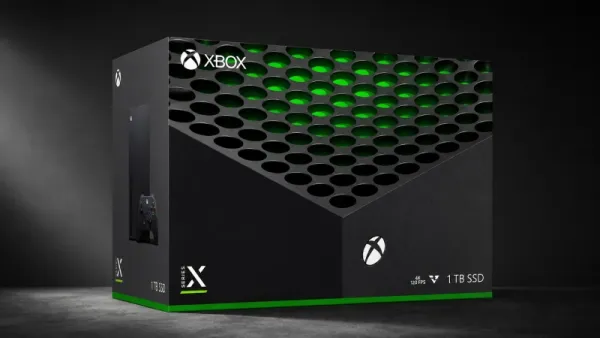
The console also supports existing Xbox One accessories, including compatible controllers and headsets. That makes upgrading less disruptive for players who already own Xbox hardware and accessories.
Storage, Connectivity and Audio
The Xbox Series X includes one HDMI 2.1 port and three USB 3.1 Gen 1 ports. Wireless connectivity is provided through dual-band 802.11ac Wi-Fi, while a Gigabit Ethernet connection is available for wired networking. The console also has a dedicated dual-band Xbox Wireless radio for compatible accessories.
Storage can be expanded through Xbox Series X|S Storage Expansion Cards, which are designed to match the performance of the internal SSD. External USB hard drives are also supported, giving users another option for storing games and other content, although the expansion card is the option designed to match internal-storage performance.
For audio, the Series X supports Dolby Digital 5.1, DTS 5.1, Dolby TrueHD with Atmos, and up to 7.1 L-PCM. Microsoft also highlights 3D Spatial Sound, which uses advanced audio algorithms to create a more immersive sound field around the player.
Design and Disc Options
The Xbox Series X has a compact vertical-oriented design measuring 15.1cm wide, 15.1cm deep, and 30.1cm tall. The standard disc-equipped model weighs approximately 9.8 pounds. Microsoft’s current lineup also includes an all-digital 1TB version and a 2TB Galaxy Black model with a disc drive, giving buyers different combinations of storage and physical-game support.
The standard Carbon Black version includes the Xbox Wireless Controller in matching Carbon Black. The controller features textured triggers and bumpers, an updated hybrid D-pad, and a dedicated Share button for capturing and sharing gameplay.
Xbox Series X and Game Pass
The hardware also sits within Microsoft’s broader Xbox ecosystem. Xbox Game Pass provides access to a large game library, with Microsoft’s Series X page highlighting hundreds of games, day-one releases, online multiplayer, and other benefits depending on the subscription tier.
That ecosystem is important because the Series X isn’t limited to individual hardware purchases. Players can combine the console with Microsoft’s subscription services, backward-compatible catalogue, Smart Delivery, and newer Xbox titles to create a broader gaming platform.
What to Watch Next
The Xbox Series X continues to occupy Microsoft’s high-performance console position, with its combination of 4K output, up to 120FPS gaming, fast NVMe storage, ray tracing, backward compatibility, and Quick Resume defining the core experience. Microsoft’s current product lineup also gives buyers more choice through 1TB disc, 1TB digital, and 2TB disc configurations.
For buyers considering the console today, the most important factors are therefore less about whether the Series X can deliver high-end console performance and more about which configuration fits their library and storage requirements. The 1TB disc model remains the traditional option, while the all-digital version removes physical media and the 2TB Galaxy Black edition provides substantially more internal storage.
Contact to : xlf550402@gmail.com
Copyright © boyuanhulian 2020 - 2023. All Right Reserved.